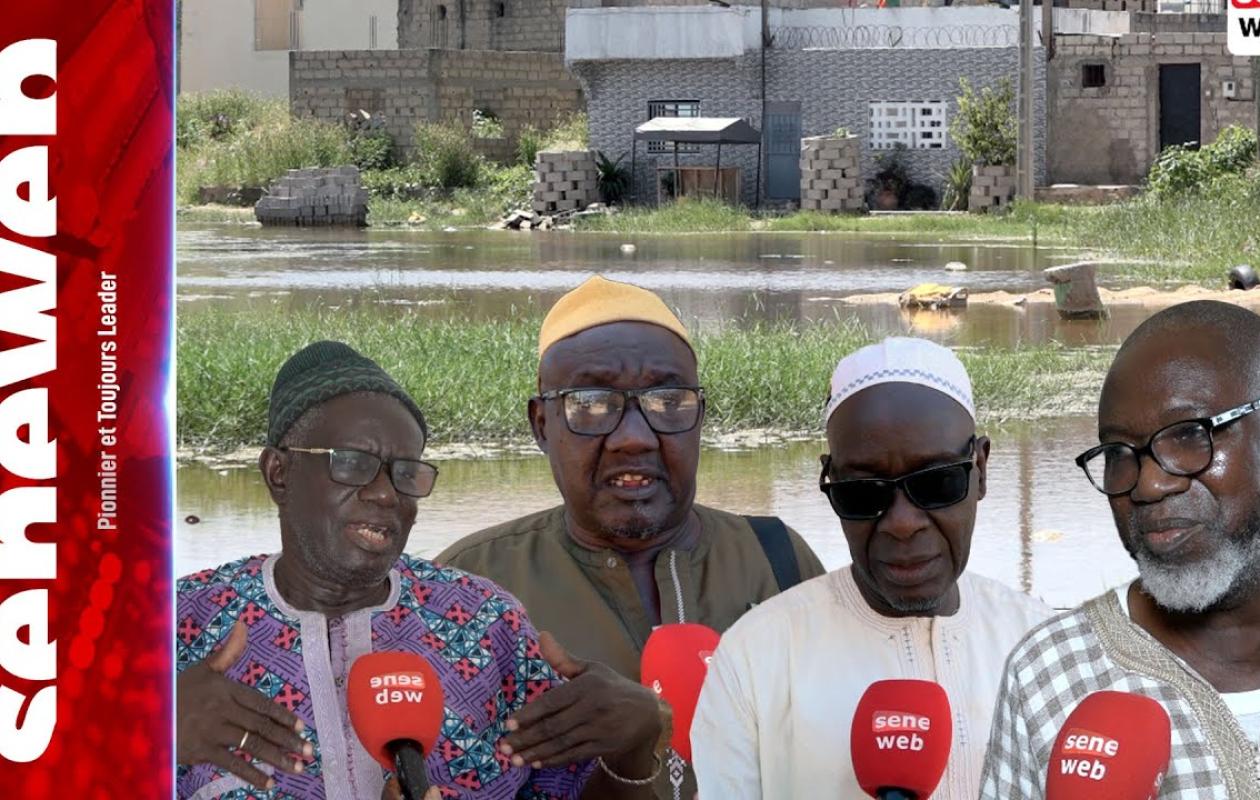
Même après l'hivernage, Kounoune reste une "Île" : le rêve d'une cité nouvelle vire au cauchemar
Despite the end of the rainy season, rainwater is omnipresent in Kounoune, a town created in the early 2000s in the Rufisque department. The initial dream of a better life in a new town has turned into a nightmare, with a lack of sanitation plunging residents into daily hardship.
A grim scene despite the end of winter.
On Tuesday, October 21, 2025, the heat failed to quench the stagnant waters. In the Maba Guissé neighborhood, the puddles and damp ground evoke painful memories of the rainy season. The lack of respite after the rainy season is devastating for the residents. The sandy roads are cracked and cut by puddles where weeds grow.
Water is everywhere, trapped by a water table that's too close. Samba Guissé, a retired teacher and one of the first inhabitants, laments: "Every time we hear the rumble of thunder, everyone is worried. In the middle of the rainy season, we find ourselves on an island, with no way out... If we want to leave, we need boots."
Impassable streets force residents to use carts to get around, with a risk of falling.
The "problem basin": a failing sanitation system
The town, originally founded by a teachers' cooperative, is facing a serious sanitation problem. The main cause, according to residents, is the retention basin dug to regulate the water, which has paradoxically worsened the situation.
Birame Cissé, a prominent figure in the town, believes: "This basin should never have been here." The water used to flow naturally towards Lake Retba (Lac Rose); now it stagnates and overflows. The basin "receives the water but cannot contain it. When it overflows, all the water flows back towards the town," adds Mr. Cissé.
The absence of drainage pipes and the very close water table are aggravating factors.
This situation has serious financial consequences. Samba Guissé testifies to the daily presence of the garbage trucks, described as "ambulances": "Thirty-five thousand francs a week... impossible for many families."
Inadequate construction and a call for state intervention
Imam Pape Samba Diouf shares the observation that the problem has worsened over the last five years and points the finger at urbanization: “Before, it was fields. An area cultivated by the village... But when the developers bought and built, they didn't take the environment into account. We are in a low-lying area, they should have thought about that before building.”
Faced with the inaction of the public authorities, the residents were forced to organize themselves. They mobilized, through contributions (50,000 francs per house), to rent equipment, dig trenches and clear canals, as they had done in 2012.
The village chief, Paul Diaham, welcomes the organization into an environmental and social committee. However, Samba Guissé insists: "The State must intervene," because simple contributions are not enough to clean up the town.
The hope for a future project
Hope lies in a recently announced project: Paul Diaham indicates that the government has launched a project, led by the ADM (Municipal Development Agency) and the World Bank, which will allow for the drainage of rainwater. The water will be directed to an outlet where a water tower will redistribute it to the market garden areas.
While awaiting the start of this project, announced for 2026, the daily lives of the people remain unchanged. Imam Pape Samba Diouf concludes, still hopeful: “We have served the state, educated generations. We deserve at least roads and dry land.”
The sanitation of Kounoune, like most of the new towns surrounding the urban center of Diamniadio, remains a significant challenge for the population.













Commentaires (31)
Malheureusement chez nous, nous construisons nos maisons avant de constater avec désolation les conséquences des années après.
L'État ayant démissionné depuis des dizaines d'années dans notre pays, les membres de coopératives d'habitation gagneraient à se sacrifier en cotisant pour faire réaliser des études puis des VRD de qualité sur l'ensemble de leur lot.
Beaucoup de désagréments pourraient ainsi être évités.
Transformer la marine française de kounoune en ville du quart d heure avec toutes les infrastructures : groupe scolaire, police, gendarmerie, sapeurs pompiers, stades, marchés, stades, mairie,s hopital
Kounoune enclavé, isolé, sans routes ni assainissement, souffre le martyr
Pas de marché, pas d hôpital
Routes ! routes ! routes !
Pourtant une bretelle reliant de 1, 5 km SEDIMA à la marine française et un périmètre de 4 km ceinturant la marine française atténuerait nos difficultés
Kounoune s’organise et sera debout pour faire face
Félicitations aux autorités de ce pays d’avoir corrigé cet accident de l’histoire en restituant au Sénégal sa souveraineté sur le centre des missions de Rufisque, communément appelé Marine française de Kounoune. Ce carré d’1 km de côté fait 1 km 2 de surface ou 100 hectares. D’abord ceinturons le par une voie de 4 km avec assainissement pour lutter contre les inondations dans les localités environnantes et désenclaver Kounoune ngalam, Zac Kounoune, Fass Kounoune, Cité Enseignants, Diakhaye, etc. Une bretelle d’1, 5 km permettra de le relier à la sortie 9 de Sedima. Une autre voie de 2km pour le relier à la sortie 10 de keur ndiaye LO qui débouche sur l’autoroute à péage verts Diamniadio.
Par ailleurs, vivement la transformation de l’ex marine française en capitale administrative avec des infrastructures publiques : police, gendarmerie, sapeurs-pompiers, mairie, hôpital, marché, groupe scolaire, institut universitaire, stade, mosquée, marché, centre commercial, etc.
Plus jamais une assiette foncière pareille ne pourra offrir ces opportunités !
Ne jamais utiliser cet espace à des fins d’habitation !
L'Etat ne suit pas la démographie, l'implantation des nouvelles cités, pas de routes, pas de canalisations, pas de police ni gendarmerie, pas d'hopitaux, pas de marchés, pas d'espèces vertes pour nos enfants. RIEN
j ai perdu mon véhicule en logeant la marne française
je fais 3 km avant d arriver à sediama , avant de prendre la voiture pour aller dans les spheres ministerielles de diamniadio
c est l enfer
ni larché , ni hopital
Demain, les populations viendront se plaindre, oubliant que ce sont elles qui ont remblayé les eaux qui s'y touvaient
impossible d aller travailler, aller à l hopital , etc
nguir yalla des routes surtout autour de la marine française
kounoune la plus grande localité de rufisque
on aime bien sonko, mais la lutte et la sanction par les urnes nous paraissent la plus grande alternative
Participer à la Discussion
Règles de la communauté :
💡 Astuce : Utilisez des emojis depuis votre téléphone ou le module emoji ci-dessous. Cliquez sur GIF pour ajouter un GIF animé. Collez un lien X/Twitter ou TikTok pour l'afficher automatiquement.