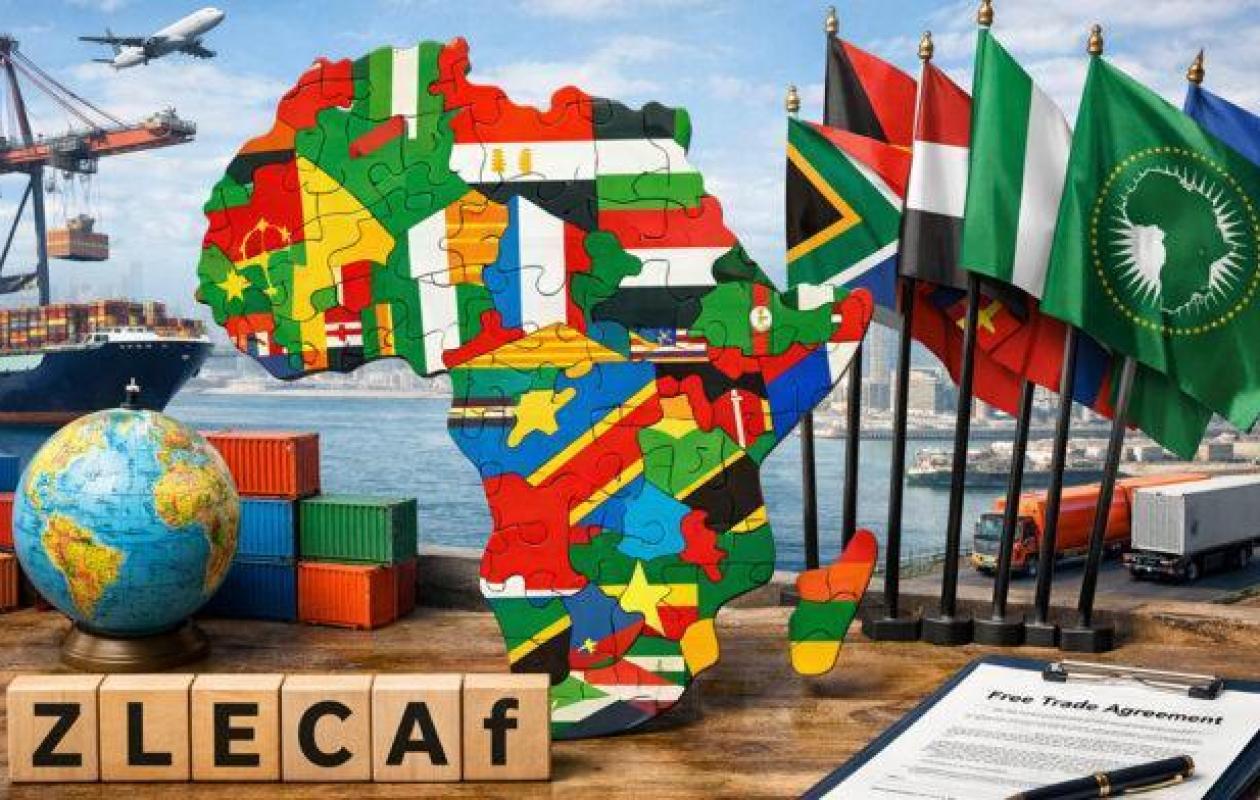
Dans les coulisses des projets d’intégration monétaire africaine
Discussions on African integration often focus on the African Continental Free Trade Area (AfCFTA), regional infrastructure, and economic cooperation projects. However, monetary issues are just as crucial. How can trade be facilitated between countries using different currencies? Should there be greater cooperation between central banks? How can financial markets be built to finance the continent's economic transformation? These topics have engaged specialized institutions for decades, one of the lesser-known being the African Centre for Monetary Studies (ACMS).
Established under the auspices of the United Nations Economic Commission for Africa (ECA), the CMEA's mission is to support thinking on monetary, financial, and banking issues in Africa. Its work consists primarily of producing studies, analyses, and recommendations for governments, central banks, and regional organizations involved in economic integration processes.
The existence of such an organization stems from an often underestimated characteristic of the African continent. Africa today has more than forty national currencies and several regional monetary unions. This monetary diversity reflects the political and economic history of African states, but it can also be an obstacle to the development of intra-African trade.
According to data from the African Development Bank and the Economic Commission for Africa, intra-African trade represents approximately 15% to 18% of the continent's total trade, depending on the calculation methods used. This level remains significantly lower than that observed in Europe or Asia. Several factors explain this situation, including infrastructure, regulatory barriers, and logistical costs, but monetary issues also play a role.
Every transaction between two countries using different currencies entails conversion costs, exchange rate risks, and sometimes additional delays. For a company exporting its products to several African markets, these constraints can represent a significant burden.
It is in this context that the CMEA has been conducting work for several years on the monetary and financial integration of the continent. The institution is particularly interested in mechanisms to facilitate cross-border payments, improve cooperation between central banks, and strengthen regional financial markets.
These considerations took on a new dimension with the development of the AfCFTA. Signed in 2018 and entering into force in 2019, this agreement aims to create the world's largest free trade area in terms of the number of participating countries. However, reducing tariffs alone is not enough to facilitate trade. Businesses must also be able to settle their transactions efficiently and at a lower cost.
The launch of the Pan-African Payment and Settlement System (PAPSS), supported in particular by the African Export-Import Bank (Afreximbank), illustrates this concern. This mechanism gradually allows African businesses to make cross-border payments in local currencies without having to systematically use international currencies such as the dollar or the euro. The work carried out by institutions like the CMEA (Collective Agreement on Economic and Monetary Affairs) is part of this same logic of reducing transaction costs within the continent.
Existing monetary unions are also an important subject of study. The West African Economic and Monetary Union (UEMOA), which shares the CFA franc and a common central bank, and the Central African Economic and Monetary Community (CEMAC) in Central Africa offer concrete examples of monetary integration. These areas represent large-scale laboratories for observing the advantages, but also the constraints, of a currency shared among several states.
The case of West Africa is being closely monitored. For over twenty years, ECOWAS has been working on the project for a single currency called the Eco. The initially planned deadlines have been repeatedly postponed due to difficulties related to economic convergence among the countries involved. The work of the CMEA regularly informs discussions on the conditions necessary for the success of such a project.
Issues of financial stability are also playing an increasingly important role in its research. The 2008 global financial crisis, the economic consequences of the Covid-19 pandemic, and the inflationary pressures observed since 2022 have underscored the importance of having resilient financial systems. African central banks must now contend with global shocks that are rapidly transmitted through financial markets, exchange rates, and commodity prices.
The institution also works on issues related to the digitization of financial systems. Electronic payments, central bank digital currencies, regional payment platforms, and financial innovations are gradually transforming the African monetary landscape. According to the World Bank and the BCEAO, Africa is among the regions of the world where digital financial services are progressing most rapidly.
These developments raise new questions for monetary authorities. How can financial stability be guaranteed while fostering innovation? How can the interoperability of payment systems between African countries be improved? How can financial inclusion be strengthened without increasing certain risks? These are all topics that are now among the priority areas of research.
The role of the CMEA is not to make monetary decisions. That responsibility lies with central banks and political authorities. Its contribution lies more in its ability to provide analysis, compare regional experiences, and foster debate on the future of African financial integration.
As the continent seeks to strengthen its trade, mobilize more local savings, and reduce its dependence on external financial circuits, monetary issues are becoming increasingly strategic. The work conducted by the African Centre for Monetary Studies is part of this perspective. Behind the discussions on currencies, payments, and financial markets lies a broader challenge: the construction of a more integrated African economic space, better able to finance its own growth.




















Commentaires (0)
Participer à la Discussion
Règles de la communauté :
💡 Astuce : Utilisez des emojis depuis votre téléphone ou le module emoji ci-dessous. Cliquez sur GIF pour ajouter un GIF animé. Collez un lien X/Twitter, TikTok ou Instagram pour l'afficher automatiquement.