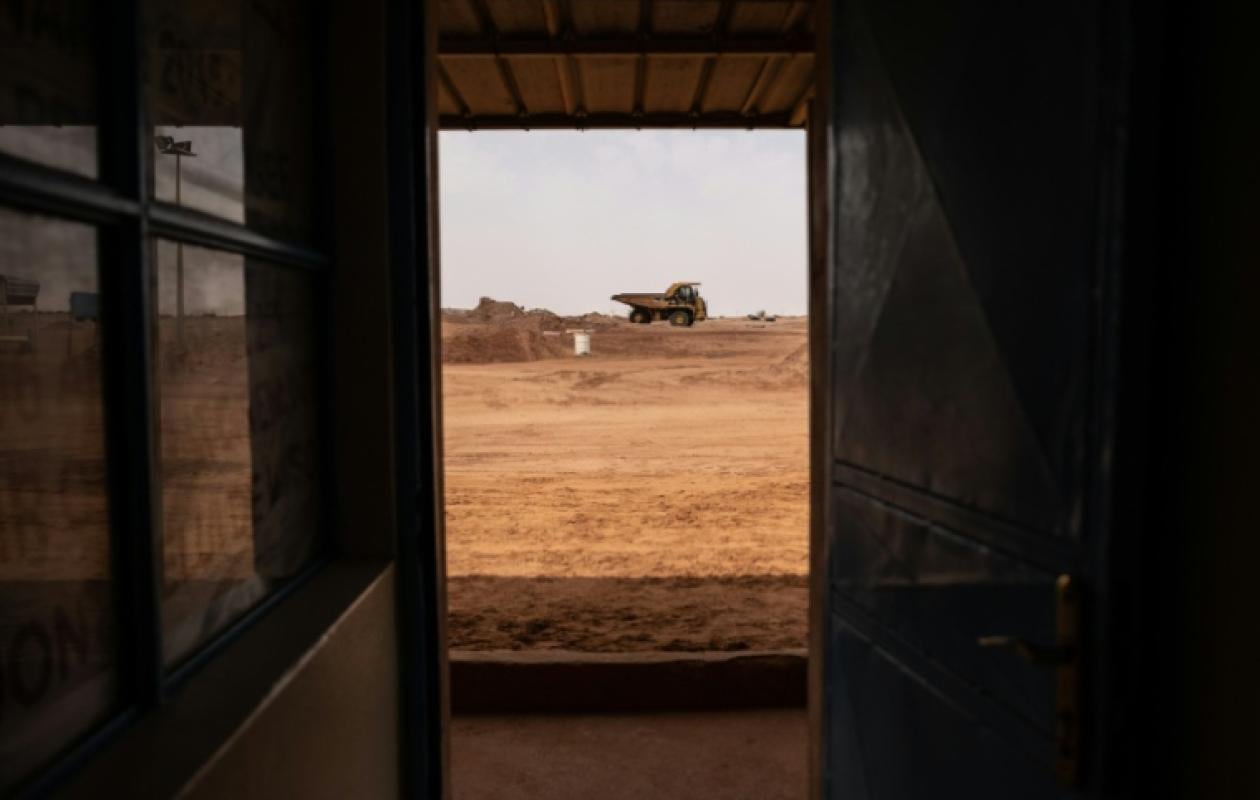
Au Niger, une embarrassante cargaison d'uranium toujours bloquée à l'aéroport de Niamey
A large shipment of uranium concentrate that left northern Niger at the end of November has been stuck at Niamey airport for several weeks, a diplomatic and strategic issue for the junta in power in this Sahelian country which has turned its back on France to get closer to Russia.
Here is what we know about this sensitive shipment estimated at at least 1,000 tonnes which Niger, governed by a military regime since a coup in July 2023, is seeking to sell.
The issue of Nigerien uranium, long exploited by the French company Orano (formerly Areva), is at the heart of the sovereignty policy claimed by the junta.
In June, it announced the nationalization of the Somaïr site, a subsidiary of Orano, located in Arlit, in the north of the country, and a few weeks later announced its intention to put the uranium produced on the international market.
AFP was able to establish, thanks to satellite images, the arrival of 34 trucks in an area of Niamey airport between December 3 and 5.
Although its contents could not be formally linked to Nigerien uranium, several sources, including the West African journalists' group Wamaps specializing in security news in the Sahel, claim that it is the 1,000 tonnes that left Arlit at the end of November.
The trucks remained within the military zone of the airport for almost a month, but by January 14, only four remained visible.
"The cargo movements are internal to Niamey airport. The merchandise is entirely within the airport premises; it has been moved to more secure locations," a source familiar with the matter told AFP.
"It is not intended to leave the territory in the immediate future," the source continued.
Because shipping goods from Niger, a landlocked country in the middle of the Sahel, requires access to the port of a neighboring coastal country.
Niger shares two borders with Nigeria and Benin.
But the ruling junta maintains strained relations with Abuja, which is among the West African countries particularly hostile to coups, and even worse relations with those in Cotonou.
Niamey is keeping its border closed with Benin, which it accuses of trying to destabilize it. As a result, it is impossible to transport goods via the most obvious and direct route, through the port of Sèmè-Kpodji, located less than 1,000 km from the Nigerien capital.
One option under consideration could therefore be to sell the "yellowcake" - the uranium concentrate - through Togo, but this involves a perilous journey through western Niger and especially Burkina Faso, which is infested with very active jihadist groups.
The theoretical route would pass, for example, through Torodi, in southwestern Niger, where the prefect was assassinated by jihadists earlier this year.
"Niger is stalling due to the growing security risk in the area," confirms the source with good knowledge of the matter.
In 2025, the Tillabéri region, bordering Burkina Faso, became "the deadliest region in the central Sahel, with more than 1,200 deaths recorded, surpassing all other regions", particularly in violence targeting civilians, according to the NGO ACLED in its overview of conflicts in Africa.
Uranium could also travel by air.
AFP was able to observe on satellite images the presence of two Russian-made Ilyushin Il-76 transport aircraft between January 9 and 13 on the tarmac of the base.
To identify the owner of the aircraft, AFP analyzed air transport tracking data, but no information concerning transport aircraft of this type was recorded.
At this time, the buyer is unknown and Moscow has not officially expressed interest in this particular shipment.
When questioned by AFP on Thursday, Russian Foreign Ministry spokeswoman Maria Zakharova said during her weekly briefing that she was unable to answer immediately and needed to "look into" the matter, assuring that she would answer it "without fail".
In the summer of 2025, the Russian Minister of Energy, during a visit to Niamey, affirmed his country's desire "to exploit uranium" in Niger.
The Russian group Rosatom and the Nigerien authorities had also signed a memorandum on cooperation in the field of civil nuclear energy.
In mid-December, an investigation was opened in France for "organized theft with the aim of serving the interests of a foreign power" concerning this uranium.
Orano considers itself wronged by a product which still belongs to it, which Niamey rejects, believing it is exercising "its sovereignty over a national resource" and accusing the French company in return of still owing it 58 billion CFA francs (more than 88 million euros) in debts and unpaid amounts.
But this procedure could cause problems for any country through which the goods would pass, starting with Togo.
"This complaint has changed the balance of power. Togo is now stalling because, under its international commitments, the goods should be seized immediately if they entered its territory," points out the source familiar with the case.
In Niamey as in Lomé, the authorities remain silent for the time being on this particularly sensitive matter.






![[EXCLUSIF]De Ziguinchor au Méridien : Le déballage explosif de Ndiaga Seck qui livre les noms et numéros de 10 de ses amants](https://image.seneweb.com/content/news/2026-21-18//thumb_1260x800_6a0b129f253e7_EAmQ8XmZt5.jpg)
![[EXCLUSIF] Ndiaga Seck : Ce qu'il a dit sur Ousmane Sonko](https://image.seneweb.com/content/news/2026-21-18//thumb_1260x800_6a0b59b4699aa_zsVjCNITAk.jpg)









Commentaires (5)
Participer à la Discussion
Règles de la communauté :
💡 Astuce : Utilisez des emojis depuis votre téléphone ou le module emoji ci-dessous. Cliquez sur GIF pour ajouter un GIF animé. Collez un lien X/Twitter, TikTok ou Instagram pour l'afficher automatiquement.