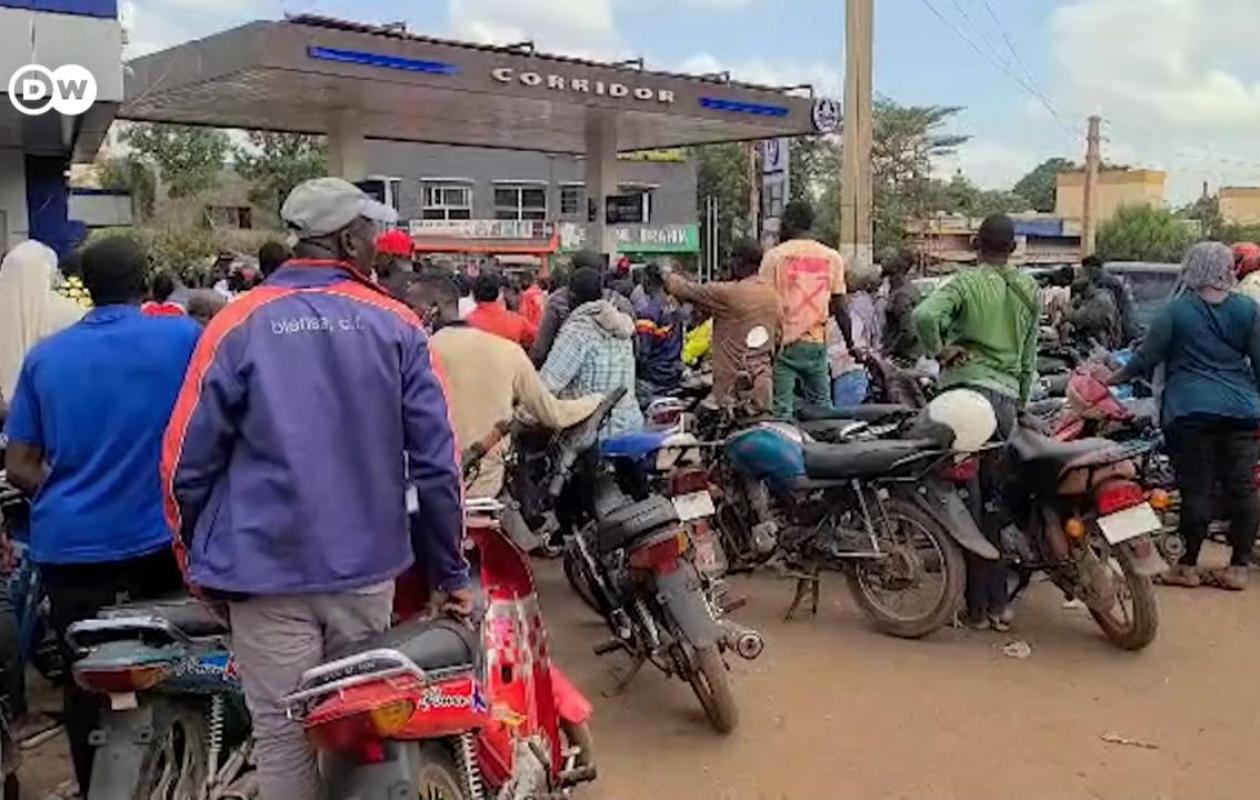
Blocus jihadiste: la capitale malienne confrontée à une pénurie de gazole
Due to a jihadist blockade that has been in place for several months in Mali, the few diesel convoys arriving in Bamako are intended to supply thermal power plants.
Mali, a landlocked country dependent on road imports, recently faced severe fuel shortages for several weeks due to jihadist attacks on convoys of tanker trucks supplying it.
Since September, jihadists from the Group for the Support of Islam and Muslims (JNIM), affiliated with Al-Qaeda, have imposed a blockade on several Malian cities and regularly attacked these convoys, suffocating the country's economy all the way to its capital.
Fuel supplies had improved significantly in Bamako since December, allowing the economy to catch its breath.
But in recent days, several service stations in the Malian capital have been running out of diesel; the little diesel that does reach the capital is destined for supplying thermal power plants.
The fuel, however, remains available.
On Tuesday, queues were growing longer outside the few remaining stocked outlets in Bamako, an AFP journalist observed.
"The trucks transporting sand and gravel are running dry," a member of the Sand Operators Association told AFP.
According to Studio Tamani, a radio station funded by a Swiss foundation, "more than 100" public transport minibuses were stopped on Monday in the Malian capital due to a lack of diesel.
"The diesel is primarily intended for Energie du Mali (EDM) whose turbines are under heavy strain during this heatwave," a member of the oil companies' group explained to AFP.
In Bamako and the regions, the electricity supply has deteriorated significantly in recent days.
On social media, many Malians are expressing their dismay and calling on the military authorities to find a solution during this month of Ramadan and this period of intense heat.
EDM, which mainly operates oil and diesel power plants, "takes all" the diesel "that comes in", says another member of this group, adding that Mali's fuel supply is disrupted by insecurity, a shortage of tanker trucks and the reluctance of transporters.
At the end of January, JNIM "summarily executed ten drivers" of tanker trucks and "two apprentices" in the southwest of the country, not far from the Senegalese border, according to a report Tuesday by the NGO Human Rights Watch.
The drivers' union had observed a work stoppage, demanding the repatriation of their colleagues' bodies before any resumption of activities.
"We were counting on convoys that are still in Dakar and Abidjan. The resurgence of attacks has disrupted the supply," an agent from the Malian Office of Petroleum Products told AFP.
The authorities have not yet made any official statements on the matter.





![[EXCLUSIF] Un gendarme auxiliaire tombe dans l'affaire Pape Cheikh Diallo](https://image.seneweb.com/content/news/2026-17-26//thumb_1260x800_69ee19493167f_XiDKaJHO1e.jpg)









Commentaires (6)
Participer à la Discussion
Règles de la communauté :
💡 Astuce : Utilisez des emojis depuis votre téléphone ou le module emoji ci-dessous. Cliquez sur GIF pour ajouter un GIF animé. Collez un lien X/Twitter, TikTok ou Instagram pour l'afficher automatiquement.