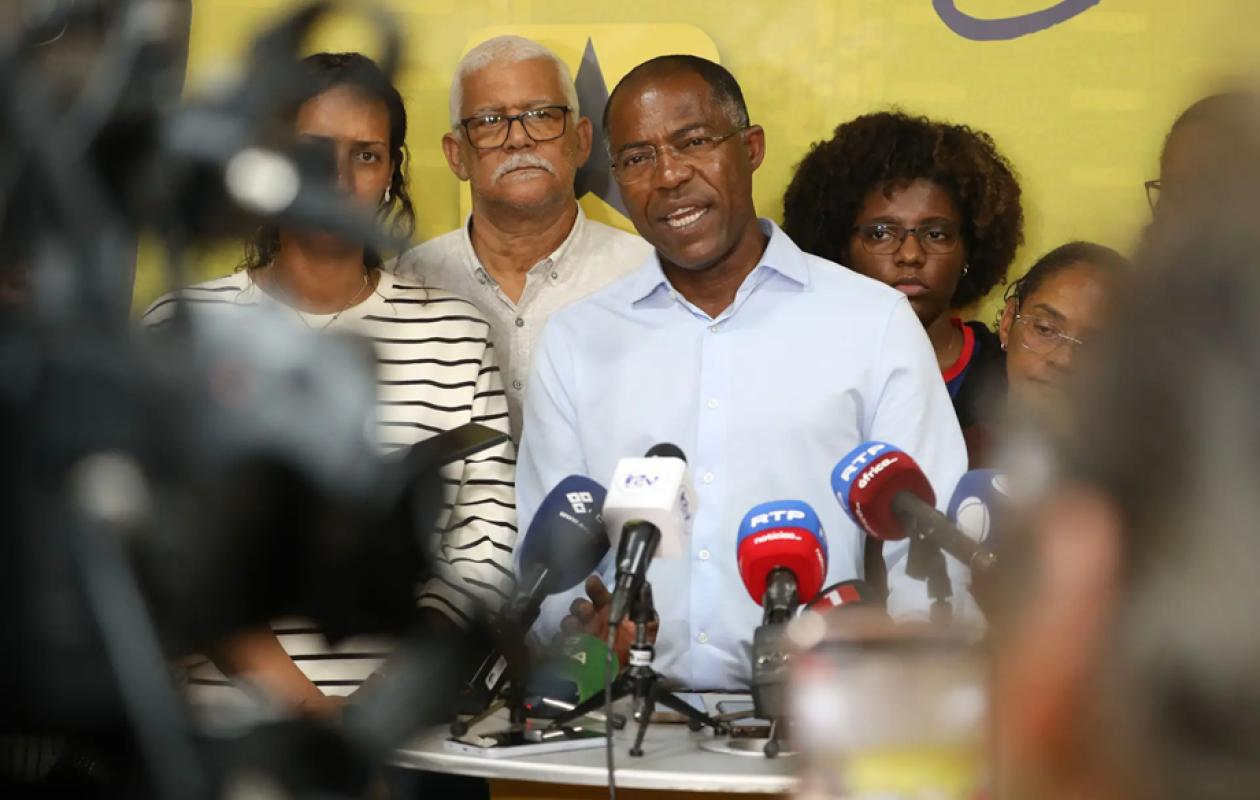
Cap-Vert: le principal parti de l'opposition remporte les législatives (résultats provisoires)
Cape Verde's main opposition party won Sunday's parliamentary elections with 46% of the vote, according to provisional results covering nearly 98% of polling stations, published overnight.
Its leader Francisco Carvalho, who has already claimed victory, becomes the country's new Prime Minister, replacing Ulisses Correia e Silva, who had been at the head of the government for 10 years.
In Cape Verde, the political system is parliamentary. The party that receives the most votes in the legislative elections chooses the head of government who dominates the executive branch, with the president (Jorge Maria Neves) playing an arbiter role.
"The Cape Verdeans have welcomed my party's message about a Cape Verde for all and that it was time to change direction and build a new Cape Verde," said Mr. Carvalho, who is also the mayor of the capital Praia.
His party, the African Party for the Independence of Cape Verde (PAICV), has obtained for the moment a relative majority with 33 of the 72 seats in the National Assembly, according to the provisional results of the national electoral commission covering nearly 98.1% of the polling stations.
The party can hope to secure at least 37 seats, synonymous with an absolute majority, when the results of the last seven seats in the country and the diaspora, which are still to be counted, are known.
In any case, the PAIVC is ahead of the party of the outgoing Prime Minister, Ulisses Correia e Silva, who was in the running for a third term after winning the legislative elections of 2016 and 2021.
Mr. Silva acknowledged the defeat of his party, the Movement for Democracy (MpD, centre-right). He said he had called the new Prime Minister to congratulate him.
"These results do not correspond to the objectives that the MpD had of winning the elections and continuing to govern the country," he said.
Far behind the two major parties, the Independent and Democratic Cape Verdean Union (UCID, Christian Democrat), the third political force in the country, won two seats, according to these still partial results.
Cape Verde, an archipelago of 550,000 inhabitants in the middle of the Atlantic, about 600 kilometers off the coast of Senegal, is renowned as a democratic model in Africa.
Since the free elections of 1991, the small West African country has not recorded any incidents or violence related to the elections and their results.
From 2011 to 2016, and from 2021 to 2026, a government and a president of the Republic of different political colors coexisted in the country.
The election year will end in November with the presidential election. The incumbent president, Jorge Maria Neves, supported by the PAICV, is running for a second five-year term.

![[EXCLUSIF]De Ziguinchor au Méridien : Le déballage explosif de Ndiaga Seck qui livre les noms et numéros de 10 de ses amants](https://image.seneweb.com/content/news/2026-21-18//thumb_1260x800_6a0b129f253e7_EAmQ8XmZt5.jpg)








Commentaires (0)
Participer à la Discussion
Règles de la communauté :
💡 Astuce : Utilisez des emojis depuis votre téléphone ou le module emoji ci-dessous. Cliquez sur GIF pour ajouter un GIF animé. Collez un lien X/Twitter, TikTok ou Instagram pour l'afficher automatiquement.