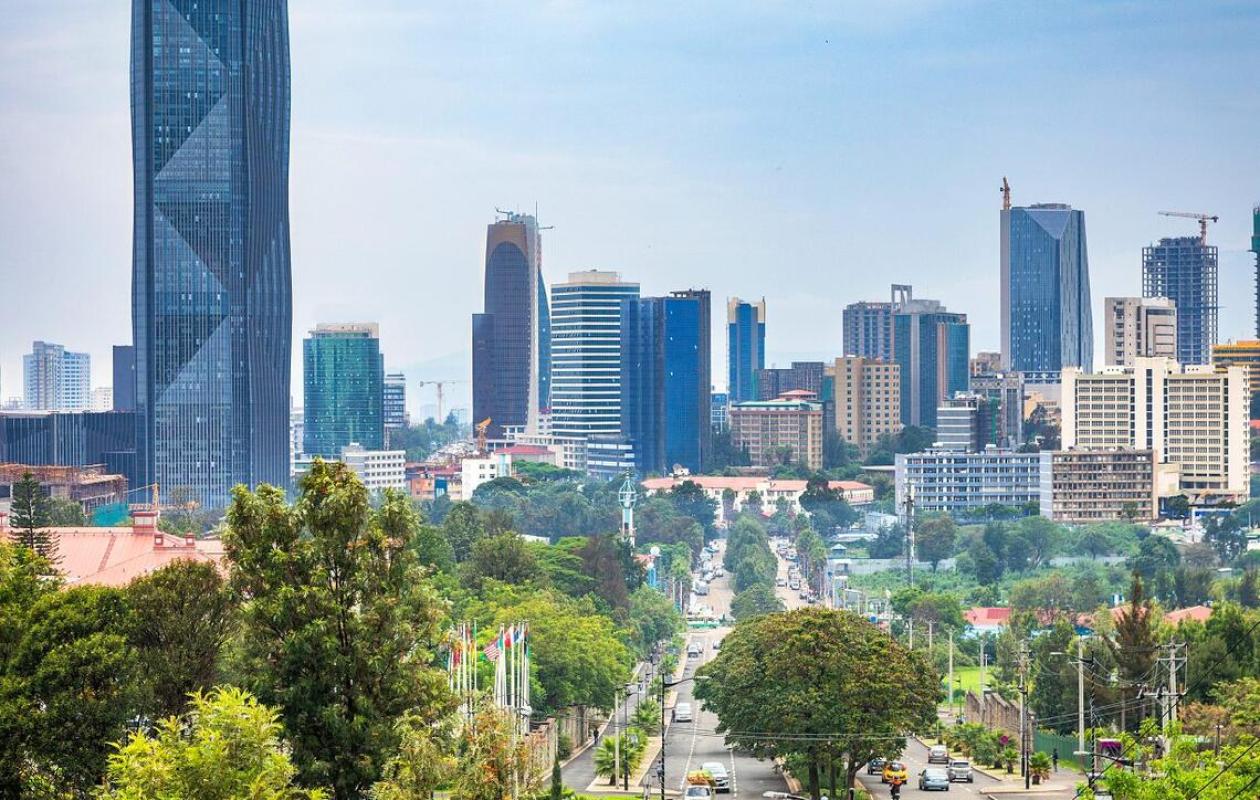
La Corne de l'Afrique, terrain d'affrontement des pays du Golfe
Composed of Ethiopia, Somalia, Somaliland, Djibouti and Eritrea, and bordering Sudan, the Horn of Africa forms the easternmost point of the African continent, facing the Red Sea which separates it from the Arab world.
This strategic location, between the Indian Ocean and the Suez Canal, on one of the world's busiest trade routes, is coveted by the petro-monarchies, at the risk of destabilizing the countries involved.
"For the Gulf States, the Horn of Africa is a crucial battleground in the geopolitical and geoeconomic competition," Anna Jacobs, a Gulf specialist, told AFP.
The United Arab Emirates has the most visible - and most criticized - presence there.
In Sudan, they are accused of arming the Rapid Support Forces (RSF) paramilitaries, who have been fighting the regular army since 2023 and are accused of massacres against the civilian population. Abu Dhabi officially denies this support.
In Somaliland, the Emirati giant DP World has invested hundreds of millions of dollars in the deep-water port of Berbera, over which it has jurisdiction. This port includes an airport strictly controlled by Abu Dhabi, according to several witnesses and local sources.
Many experts claim that the Emirates, which are close to Israel, are behind the Israeli government's recognition in late December of Somaliland, a self-proclaimed republic that seceded from Somalia in 1991.
Israel could gain a base in Berbera from which to strike the Houthis in Yemen, allies of Iran, who threaten its territory. But its recognition of Somaliland, a long-awaited first for this territory, severely weakens the Somali state, already on the ropes after two decades of fighting against the al-Shabaab Islamist group, an armed group affiliated with al-Qaeda.
Abu Dhabi is ready to "take risks" to try to "shape the regional order," says Anna Jacobs.
But this diplomatic stance is distancing it further and further from Saudi Arabia, once a strong ally.
The two monarchies joined forces in 2014 against the Houthis. However, the alliance has fractured, and openly imploded a month ago, with Riyadh's bombing of a suspected arms shipment destined for Yemen and originating from the Emirates.
Saudi Arabia, traditionally focused on "supporting state institutions and the status quo", according to Ms. Jacobs, is now going on the offensive against its new enemy, including in the Horn of Africa.
According to a Somali government source, Riyadh, in order to counter the Emirati advance, "is preparing a tripartite military agreement between Somalia, Saudi Arabia and Egypt", which AFP bureaus in Cairo and Saudi Arabia could not confirm.
The Somali government has simultaneously cancelled all agreements linking it to the Emirates.
"The influence of the Gulf countries in the Red Sea only serves to perpetuate instability," laments Biraanu Gammachu, an Ethiopian analyst.
"These are asymmetrical relations, between powerful oil-producing countries and states that depend on international aid," and their ascendancy over the countries of the Horn of Africa is "worrying," he emphasizes.
The giant of the region, Ethiopia, the second most populous state in Africa with some 130 million inhabitants, is equally concerned.
Since Prime Minister Abiy Ahmed came to power in 2018, the Emirates, in addition to the Prime Minister's Palace, have multiplied their investments there, including a $3 billion loan in 2018 and a 2023 agreement for a currency swap that has helped to support the Ethiopian currency, making Ethiopia "a vassal state," Cameron Hudson, a former Africa analyst for the CIA, one of the American intelligence agencies, told AFP.
In December, a source close to the Sudanese army accused Ethiopia of hosting a training base for the Sudanese Forces paramilitaries on its soil. When contacted by AFP, Ethiopian authorities did not respond.
The dissension between petro-monarchies also raises the risk of a new conflict between Ethiopia and Eritrea, whose historically abysmal relations have worsened in recent months.
Eritrea gained its independence from Ethiopia after decades of armed struggle in 1993. Eritrean President Isaias Afwerki, who has ruled the country unchallenged since 1993 and limits his travel abroad, visited Saudi Arabia twice in 2025.
In a recent interview, Mr. Issaias criticized the "destabilizing" role of the Emirates in Sudan.
Eritrea has also grown closer in recent months to Egypt, which has acrimonious relations with Ethiopia, after Addis Ababa built a dam on the Nile, which Cairo considers an "existential threat".
In such a context, direct Ethiopian involvement in the conflict in Sudan would "very likely" push Eritrea "to become more directly involved in supporting the Sudanese army and to strengthen its own influence operations in Ethiopia," warns Cameron Hudson, who is alarmed: "This could very quickly escalate into a regional conflict."





















Commentaires (2)
Participer à la Discussion
Règles de la communauté :
💡 Astuce : Utilisez des emojis depuis votre téléphone ou le module emoji ci-dessous. Cliquez sur GIF pour ajouter un GIF animé. Collez un lien X/Twitter, TikTok ou Instagram pour l'afficher automatiquement.