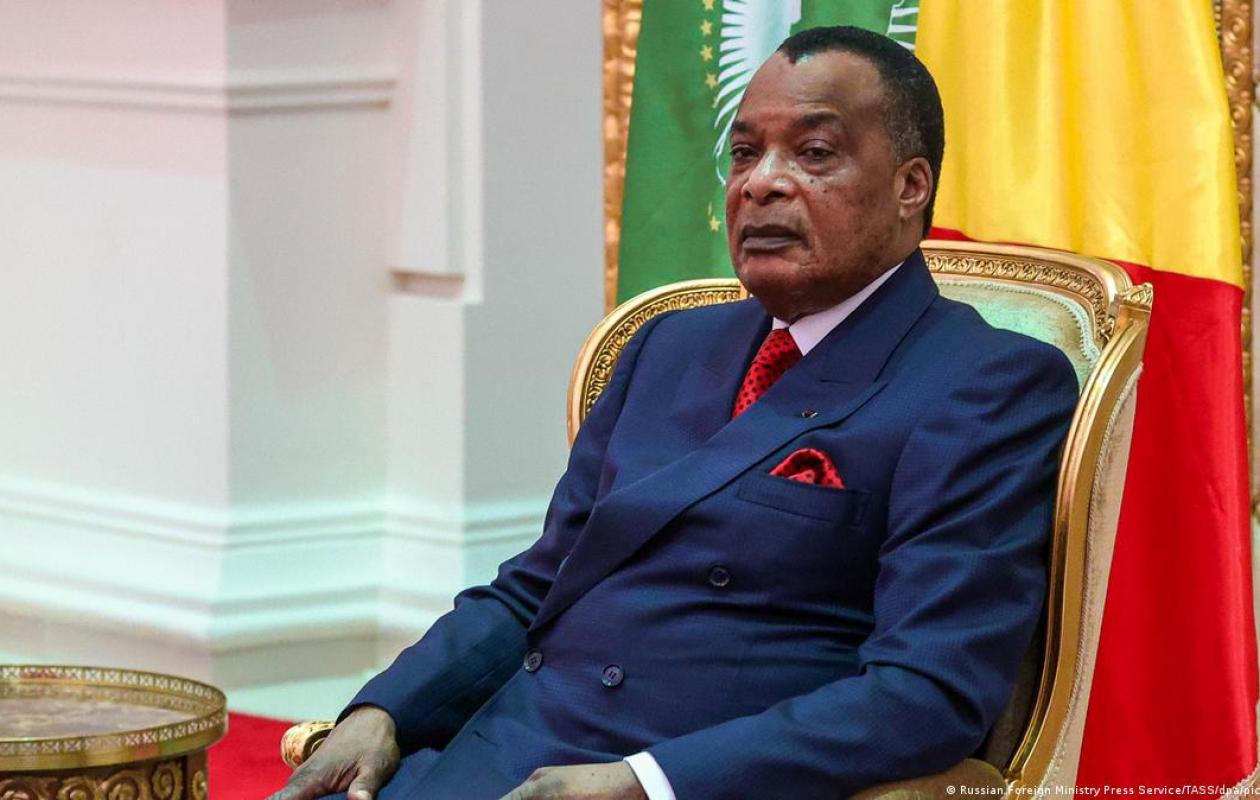
Présidentielle au Congo: une formalité annoncée pour l'inamovible Sassou Nguesso
After ruling this oil-rich Central African country from 1979 to 1992, during the time of the single party, Mr. Sassou Nguesso regained power by force in 1997, after four months of civil war in Brazzaville.
Re-elected without any real opposition since then, he has not designated a successor and holds the reins of his country of six million inhabitants with an iron fist, brushing aside criticism of the authoritarian and predatory nature of his power or accusations of human rights violations.
Since the start of the election campaign at the end of February, giant portraits of the "patriarch" and the red flags of his Congolese Labour Party (PCT) - which recall his Marxist-Leninist origins - have invaded the streets of major cities.
The main opposition parties announced they would boycott the election, believing that the conditions for a free and transparent election had not been met.
Only six candidates, little known or without a real political base, are running against Denis Sassou Nguesso, with little chance of preventing his re-election for a new five-year term in the first round.
Observers fear massive abstention. And indeed, the Congolese people interviewed showed little enthusiasm for an election that seemed to them to be a foregone conclusion.
"Honestly, I don't see the point in going to vote on March 15th. In any case, whether I do it or not, we will have the same elected official," says Cyril Massamba, a resident of the Bacongo district in Brazzaville.
"I will be in a polling station the day my own child is a candidate," quips Monique Ouollo, a trader from Bacongo.
President Sassou Nguesso urged voters to go to the polls. "No abstention!" he declared at a rally in Pointe-Noire, the country's second-largest city, on the first day of the campaign.
While the candidate highlighted his economic record, including the modernization of infrastructure, the development of the gas sector and agriculture to make Congo self-sufficient, many young people present at this meeting criticized the lack of opportunities and jobs.
The country is rich in oil and gas, which provide the vast majority of state revenue and drive growth, estimated at 2.9% in 2025. But almost half of the population lives below the poverty line, according to the World Bank.
Critics of the head of state argue that the country's development has been hampered by massive embezzlement of public money and oil revenue at the highest levels of government.
The Sassou Nguesso family, whose fortune is difficult to estimate, is the subject of several investigations and complaints for embezzlement, notably in France, in the so-called "ill-gotten gains" case, or in the United States.
The accusations were described as attempts at destabilization by the authorities.
The case of acquired assets has damaged the historical relationship between Denis Sassou Nguesso and France, the former colonial power.
As the country's largest donor of aid, it remains a key player in the country's economy, even though the Congolese president skillfully plays on his ties with China but also with Russia, with which relations are long-standing.
"In a multipolar world, Congo plays on the rivalries between France, the Middle Eastern powers, Russia and China to gain respectability while strengthening the authoritarian power in place," wrote Laurent Duarte and Thibaud Kurtz in 2025 in a note from the French Institute of International Relations (Ifri).
During the Pointe-Noire meeting, the presence of foreign paramilitaries fueled speculation about the possible presence of Russian mercenaries providing security for the Congolese president.
A PCT official confirmed to AFP the presence of Russians, without specifying the nature of their mission.
Although Denis Sassou Nguesso's re-election seems assured, the real issue of the election appears to be the aftermath and the inevitable question of his succession.
"We will not remain in power forever" and the "turn" of the young people "will come," the Congolese president assured AFP during an interview on March 1, while refusing to comment on a possible successor.
Several names are sometimes mentioned in his entourage: his son Denis Christel Sassou Nguesso, Minister of International Cooperation, his special advisor Jean-Dominique Okemba, or Jean-Jacques Bouya, Minister of Territorial Development and Major Works.
"This is not about preparing one man," the president told AFP, "it is about a set of things that we are preparing globally for the future of the country."







Commentaires (3)
Participer à la Discussion
Règles de la communauté :
💡 Astuce : Utilisez des emojis depuis votre téléphone ou le module emoji ci-dessous. Cliquez sur GIF pour ajouter un GIF animé. Collez un lien X/Twitter, TikTok ou Instagram pour l'afficher automatiquement.