Sahel : chronique d'un effondrement annoncé
From Mali to Niger, via Burkina Faso, the three military regimes that came to power in the coups of 2021, 2022, and 2023 are experiencing a crisis whose scale now exceeds their communication capabilities. An unprecedented jihadist offensive, besieged capitals, hundreds of civilians killed, and Russian mercenaries in retreat: what happened in the Sahel between April 25 and May 14, 2026, marks a historic turning point. Account and analysis.
The Saturday that changed everything
At 5:00 a.m. on Saturday, April 25, 2026, the first explosions shook Kati, a garrison town located fifteen kilometers from Bamako. At the same time, in six other Malian cities (Bamako, Kidal, Gao, Mopti, Sévaré, and Bourem), dozens of coordinated attacks were launched simultaneously against military installations, airports, and government buildings. This was the most coordinated operation ever carried out by a non-state armed group in the history of the Sahel conflict.
The perpetrators were identified within hours: the Group for the Support of Islam and Muslims (JNIM, affiliated with Al-Qaeda) and the Tuareg rebels of the Azawad Liberation Front (FLA). The death toll rose steadily. General Sadio Camara, the Minister of Defense, was killed in his residence in Kati by a suicide bomber driving a car bomb. The head of Malian intelligence, Modibo Koné, was seriously wounded. A Russian Mi-8 helicopter belonging to the Africa Corps was shot down in the Gao region. And Kidal, a strategic city recaptured in November 2023 by Malian forces supported by Russian mercenaries, fell within hours into the hands of the FLA and JNIM.
The Malian junta officially acknowledges only sixteen wounded. A hospital source quoted by AFP reports twenty-three deaths in the fighting in Kati alone. The Chief of Staff mentions, without being able to provide evidence, "more than two hundred terrorists neutralized." The true figures will remain unknown for some time.
The confidential preliminary report from the African Union Counter-Terrorism Centre, dated April 26, 2026, and circulated among embassies in the region, describes the operation as a strategic turning point. It documents three key elements. In Sévaré, JNIM fighters infiltrated the area by posing as civilians before the arrival of motorized reinforcements, an urban penetration technique that presupposes long-established sleeper cells. During the assault on Kidal, JNIM sent a direct political message to Moscow: “Do not interfere in this fight. In exchange, we will maintain good relations.” Finally, the African Union experts conclude that these attacks constitute a “replicable model” in Burkina Faso, Niger, and beyond to coastal states.
"What JNIM did in Mali can be done in Burkina Faso, Niger, and potentially in coastal states." African Union Counter-Terrorism Centre, Preliminary Report, April 26, 2026.
Twenty days that confirm the rout
The twenty days following the offensive do not resemble a counterattack. They resemble a slow demonstration of what the Malian junta can no longer do.
In Kidal, approximately four hundred fighters from the Afrika Korps, the Russian mercenaries tasked with ensuring the security of the North, negotiated their own withdrawal with the FLA rebels. Evacuated under enemy escort to Tessalit, they abandoned the Malian soldiers there, who were taken prisoner. "The Russians betrayed us in Kidal," a Malian official told Radio France Internationale, speaking on condition of anonymity. The Russian Ministry of Defense officially confirmed the withdrawal.
On May 1st, Tessalit and Aguelhoc fell in turn, without any fighting taking place. The Africa Corps abandoned their positions, leaving equipment behind. The FLA took possession of a military airstrip near the Algerian border and announced its intention to successively "liberate" Gao, Timbuktu, and Ménaka.
Three days after the offensive, the head of the junta, Assimi Goïta, finally spoke. In a televised address, he denounced "a vast destabilization plan, conceived and executed by armed terrorist groups and their internal and external sponsors." He did not name these sponsors. The following day, he received the Russian ambassador, Igor Gromyko, who "reaffirmed Russia's commitment to Mali." The same Russians who had just withdrawn from Kidal.
On April 28, JNIM spokesperson Bina Diarra issued a statement in French, an unusual move for an organization that typically communicates in Arabic and local languages. The statement, addressed "to all segments of Malian society," announced a new phase: "Starting today, a blockade is being imposed on Bamako on all roads." For the first time since the beginning of the conflict, an Al-Qaeda-affiliated group was besieging a national capital and calling on its inhabitants to form a "common front" against the junta.
On May 6, while Bamako was dealing with the shock of the blockade, two villages in the Bandiagara region, Kori-Kori and Gomossogou, were attacked simultaneously at 4:00 PM. More than sixty civilians were killed, according to the Dozo hunters of Dana Ambassagou. No official death toll was released. It would be five days before a government delegation arrived by helicopter, bringing twenty-five tons of millet and twenty million CFA francs. A symbolic response to a massacre whose true significance is immeasurable: the war against civilians continues, methodical and silent, in areas where the state has lost all control.
Niger: Bankruptcy foretold
In neighboring Niger, the Malian offensive of April 25th was not merely observed as a regional event. The government interpreted it as a direct warning. Indeed, on the same day, in a statement relayed by Sahelian sources, the FLA explicitly called on "Niger and Burkina Faso to stay out of what is happening in Mali." The interpretation took hold in both Niamey and Ouagadougou: your turn will come.
The toll of the junta led by General Abdourahamane Tiani, in power since July 26, 2023, is being published by international organizations with unflinching precision. According to ACLED, the leading global database on armed conflicts, the Islamic State in the Sahel has killed approximately 1,600 Nigerien civilians since the coup. In the Tillabéri region alone, bordering Mali and Burkina Faso, Human Rights Watch has documented more than five separate massacres since March 2025, totaling at least 127 summary executions. Several witnesses cited in these reports state that the Nigerien army was alerted before these attacks and failed to intervene.
On January 28, 2026, an event marked a symbolic turning point: the airbase located at the Diori-Hamani International Airport in Niamey was attacked. The Islamic State claimed responsibility for the operation, describing it as a "coordinated and planned attack." The junta referred to it as a "repelled attempt" and accused "foreign-controlled mercenaries" without providing any evidence. But the fact remains: the capital of a country that had promised to restore security saw its main infrastructure targeted two and a half years after the coup.
This deteriorating security situation is compounded by a tense political climate. Mohamed Bazoum, elected president in an election hailed as the first democratic transfer of power in Niger's history in 2021, has been detained in the presidential palace since the first day of the coup. In February 2026, the UN Working Group on Arbitrary Detention concluded that this detention was unlawful and called for his immediate release. The junta did not respond. The transitional charter adopted in March 2025 extends the military period until 2030, with an extension clause in the event of "security risks."
On April 30, 2026, Operation "WIBGA-2" was launched as an emergency measure by the Burkinabe Ministry of Security. The population was urged to monitor barracks, airports, and government buildings. Within seventy-two hours, both Ouagadougou and Niamey understood that what JNIM had just done in Bamako could be replicated in their own countries.
"Do not get involved in this fight. These events do not concern Niger and Burkina Faso." FLA, statement of April 25, 2026.
Burkina Faso: A State in Disappearance
Burkina Faso is rarely discussed. And for good reason: for several months now, foreign journalists have been systematically blocked at the borders or expelled. France 24 has been suspended. Correspondents from major international news agencies are working under restrictions. Information is getting out, but only in dribs and drabs.
What international organizations' reports nevertheless document is striking. In its 2026 global report, Human Rights Watch states that by the end of 2024, forty localities in Burkina Faso were under a state of effective siege, cut off from all external supplies. Two million people were living without regular access to food, medical care, and fuel.
On the ground, the war against civilians has taken on a systemic dimension. In May 2025, hundreds of JNIM fighters invaded the town of Djibo in the Sahel region, seizing control of a military base and killing at least 26 civilians. In August 2025, in the village of Youba, 14 people were killed, including four children. The reason reported by survivors: the community refused to stop cultivating crops that the jihadists deemed too tall to allow for surveillance of the land.
Captain Ibrahim Traoré, in power since September 2022, has invested over 600 billion CFA francs in defense. He has armed tens of thousands of Volunteers for the Defense of the Homeland, civilians mobilized under minimal security conditions, and repeatedly accused of abuses against the communities they were supposed to defend. The documented result is unambiguous: areas under jihadist control have continued to expand. And the promise of a return to constitutional order is no longer on the agenda.
A house of cards, three parallel trajectories
Read separately, the three cases (Mali, Niger, Burkina Faso) might appear as distinct crises, each linked to its national specificities. Read together, they tell a different story: the simultaneous failure of a political model that claimed, in all three countries, that a military government free from democratic constraints could restore the security that elected governments had failed to guarantee.
The facts are now well-documented. The three juntas expelled French and American forces, welcomed the Russian Africa Corps, suspended democratic institutions, dissolved political parties, muzzled the press, and imprisoned or forced the political opposition into exile. And in all three countries, two to five years after seizing power, the security situation is objectively worse than at the time of the coup.
According to ACLED's regional report published in May 2026, the Sahel accounted for more than half of all terrorism-related deaths worldwide by 2025. The same study highlights the growing operational capabilities of armed groups: increasing use of armed drones, strategies of prolonged economic siege, and the capacity for coordinated urban assaults. What analysts described as a rural insurgency in 2015 has, ten years later, transformed into a quasi-state threat.
Faced with this development, the official narrative of the three juntas remains unchanged: announced victories, designated enemies abroad, and international media accused of conspiracy. But the events they seek to conceal (the fall of Kidal, the attack on Niamey airport, the blockade of forty Burkinabè cities) are now of such magnitude that official communication itself is losing its protective function.
And then what?
The question being asked today by chancelleries, regional organizations, and analysts across the continent is what can succeed this model. Several initiatives are emerging, outside the corridors of power.
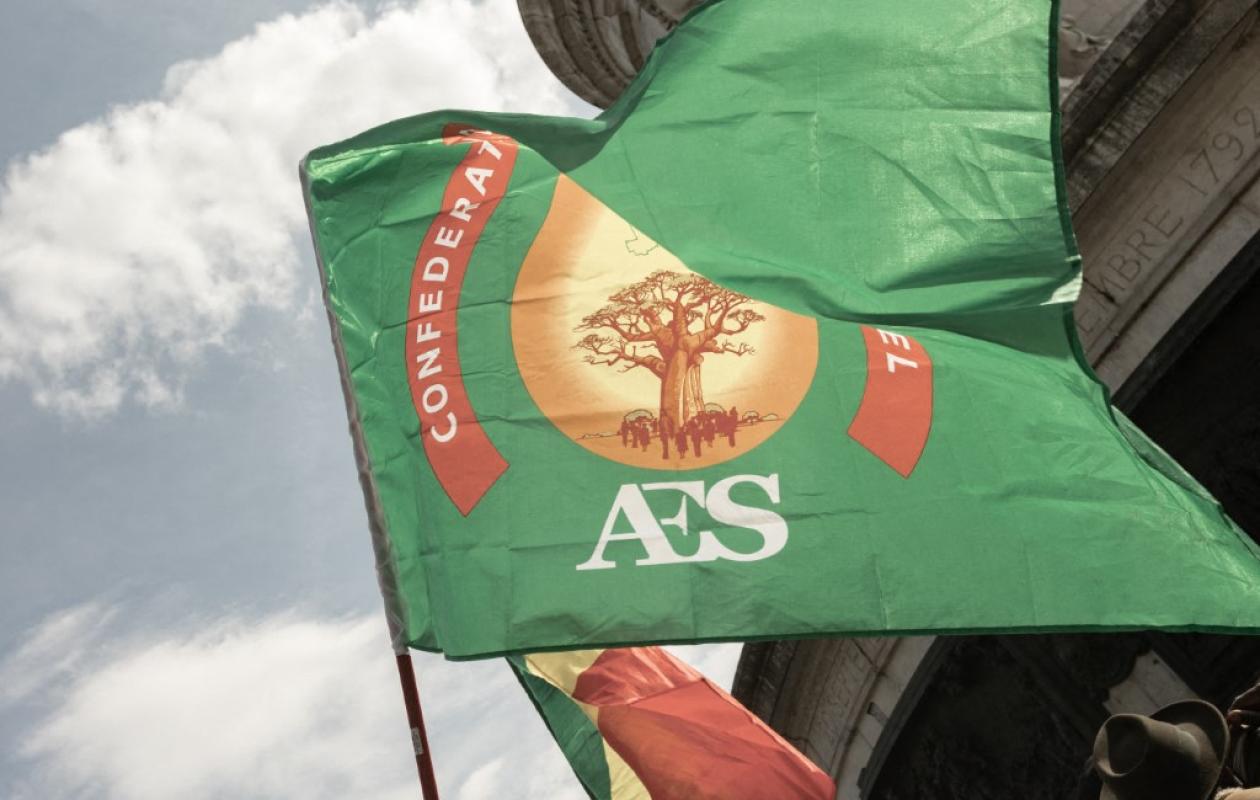
In Mali, the Coalition of Forces for the Republic (CFR), founded in December 2025 and led by Imam Mahmoud Dicko, proposes a national dialogue with all actors, including armed groups, based on two fundamental principles: the unity of Mali and democracy. In Brussels, the Alliance of Democrats of the Sahel (ADS), founded on April 7, 2026, under the presidency of Dr. Mayra Djibrine, a physician from Niger, brings together democratic forces from the three countries of the Alliance of Sahel States and proposes a regional framework for transition.
The question that will arise in the coming months is no longer whether the three Sahelian juntas will survive in their current form. Their trajectory, as interpreted in light of the events of April 25, 2026, does not suggest this will be the case. The question is who will be able to fill the political vacuum they will leave, and according to what agenda.
The Sahelian house of cards has long rested on a single foundation: the fear of chaos, exploited by military regimes to justify their hold on power. April 25, 2026, showed that this foundation no longer holds. Chaos is already here. And the political question now is what can be built from its ruins.

















Commentaires (27)
Participer à la Discussion
Règles de la communauté
💡 Astuce : Utilisez des emojis depuis votre téléphone ou le module emoji ci-dessous. Cliquez sur GIF pour ajouter un GIF animé. Collez un lien X/Twitter, TikTok ou Instagram pour l'afficher automatiquement.
Se connecter
Commentez avec votre profil, votre photo, et soyez averti des réponses.