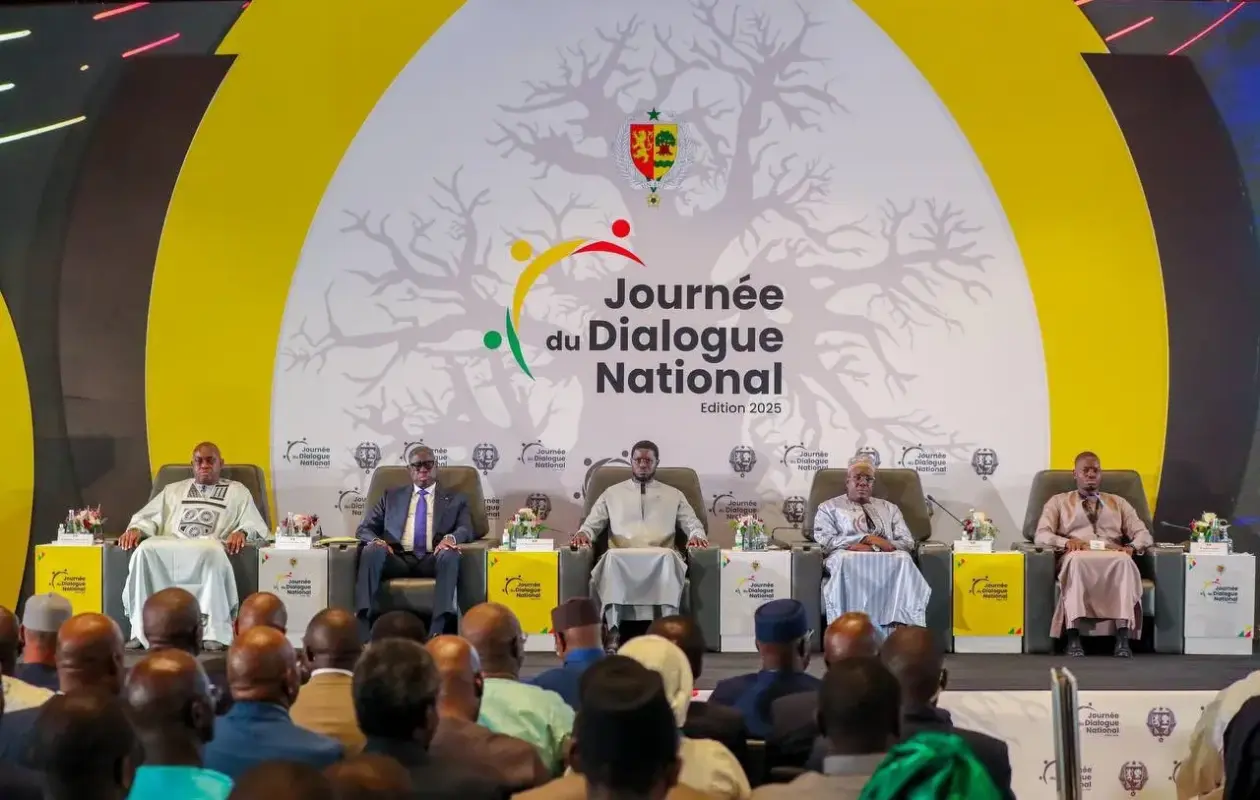
Quand le dialogue national change de salle mais pas de soupçons
In Senegal, the national dialogue has become an institution almost as sacred as the debates about sheep prices in the lead-up to Tabaski. Every year, or nearly so, key stakeholders gather around a table to talk about themselves, the nation, its divisions, its urgent needs, and its promises. But this time, the meeting on May 28, 2026, takes on a particular character: less fanfare, less solemnity, and above all, much more discretion.
Officially, the streamlined format favored by President Bassirou Diomaye Faye is explained by the proximity of Tabaski (Eid al-Adha). This argument is valid. Between religious obligations, family travel, and the high cost of living, it's difficult to imagine entire days of national consultations involving the administration, political parties, and civil society. The real Senegal sometimes has more pressing priorities than the institutional Senegal.
But in politics, formats are never neutral. And that's precisely where the questions begin. The shift from public dialogue to private meetings profoundly alters the perception of the process. In the Senegalese political imagination, closed-door meetings have never been viewed favorably. They evoke backroom deals, silent compromises, unexpected alliances, or strategic recalibrations. Consequently, every discreet encounter between the government and the opposition becomes a national issue, fueling suspicions, interpretations, and political maneuvering.
The paradox is all the more striking given that the head of state has consistently championed consultation and inclusion since taking office. President Diomaye Faye clearly aims to establish a culture of ongoing dialogue, a far cry from the political crises that have shaken the country in recent years. In principle, this intention is difficult to dispute. A fractured nation needs dialogue, listening, and spaces for mediation.
But the method raises questions. First, because several announced institutional reforms seem to already be underway in the administrative processes. Second, because the president has already held consultations, notably with the major trade unions, on the occasion of Labor Day, last May 1st .
Many are wondering what the true scope of the planned discussions from May 21 to 31 will be: is it an open consultation intended to enrich future decisions or an exercise in political validation of choices already made?
Added to this is another, even more political element: the perceptible tensions between the president and a segment of his own party, particularly within PASTEF. Criticism from certain party officials fuels the perception of a divergence between the institutional management of power and the expectations of a more radical grassroots activist base. In this context, every presidential dialogue with the opposition is immediately interpreted through the lens of the internal power dynamics.
This is why several observers believe that simply postponing the national dialogue would have been more transparent. A decree to reschedule the meeting until after Tabaski would have preserved the public and symbolic nature of this day, established by presidential decree under the previous regime. This would likely have avoided the impression of a fragmented dialogue, spread over ten days and conducted behind closed doors.
Ultimately, the question isn't whether dialogue is useful. In a democracy, it always is. The real question is one of trust. And in politics, trust isn't built solely on intentions; it also thrives on transparency, clarity, and consistency in the methods chosen for governing.












Commentaires (5)
Participer à la Discussion
Règles de la communauté
💡 Astuce : Utilisez des emojis depuis votre téléphone ou le module emoji ci-dessous. Cliquez sur GIF pour ajouter un GIF animé. Collez un lien X/Twitter, TikTok ou Instagram pour l'afficher automatiquement.
Se connecter
Commentez avec votre profil, votre photo, et soyez averti des réponses.