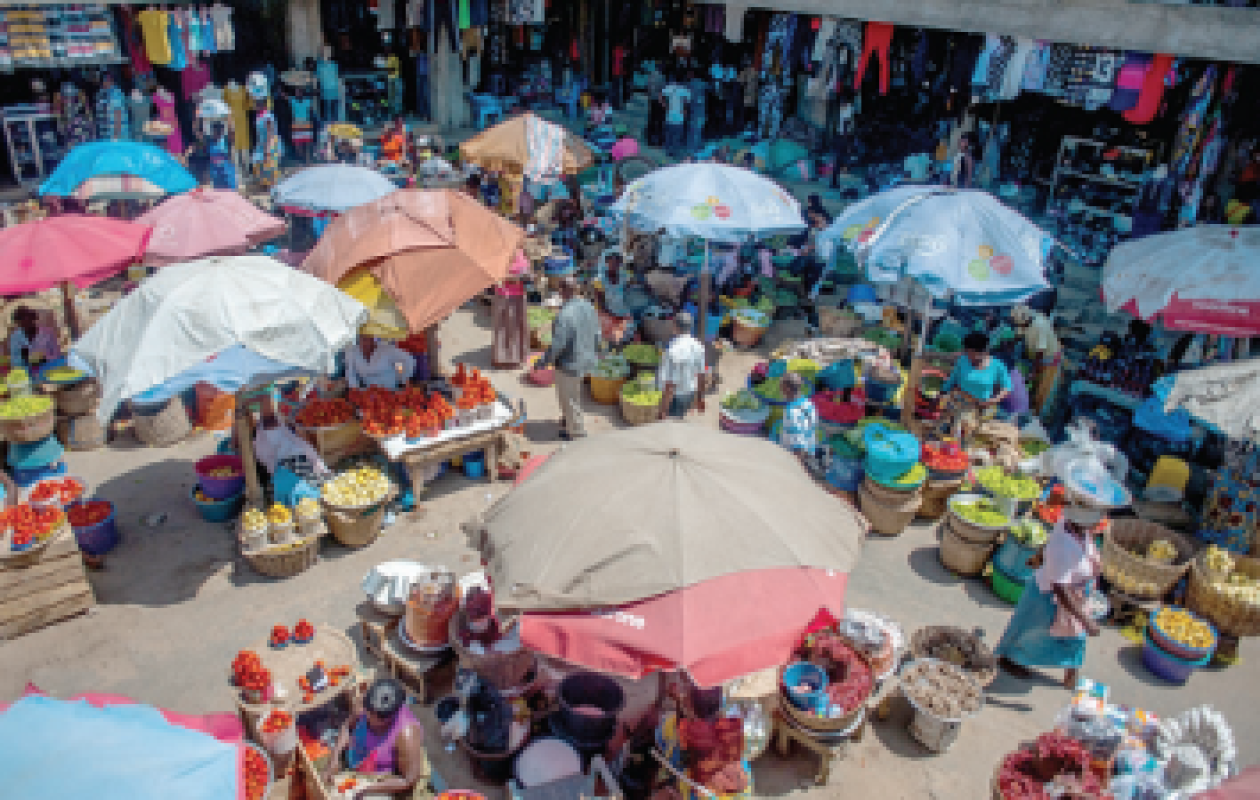
Entre refuge et contrainte : le rôle ambivalent de l’économie informelle
In many African countries, the informal economy plays a central role in absorbing labor in the absence of sufficient formal employment. It allows a large portion of the working population to generate immediate income and cushion economic shocks, particularly during economic downturns or social crises. This function as a refuge explains its persistence and expansion, especially in urban areas, where informality is becoming a dominant mode of economic integration.
However, this absorptive capacity is accompanied by profound structural limitations. Informal activities are characterized by low productivity, reduced capital intensity, and high vulnerability to economic fluctuations. Incomes are unstable and often insufficient to allow for capital accumulation or long-term investment. Consequently, informality provides immediate subsistence but rarely a path toward sustainable improvement in living conditions.
The lack of social protection constitutes another major vulnerability. The majority of informal workers have neither health insurance, nor pension coverage, nor any mechanisms for protection against occupational risks. This situation implicitly shifts the cost of economic and health shocks onto households themselves, increasing their vulnerability to poverty in the event of illness, accident, or old age. The social safety net provided by the informal sector thus appears incomplete and precarious.
At the macroeconomic level, the prevalence of informality reduces the state's fiscal capacity. Low tax revenue limits the financing of infrastructure, public services, and social policies, while simultaneously increasing dependence on external resources. This vicious cycle constrains public action and hinders economic modernization, as the investments necessary for productivity growth remain insufficient.
In the long term, the informal economy tends to solidify the productive structure rather than facilitate its transformation. While it remains essential as a mechanism for social adjustment, its widespread adoption cannot constitute a sustainable development model. The challenge for public policy lies in facilitating gradual pathways to formalization by improving the business environment, access to finance, and social protection, so that informality ceases to be a mere refuge and becomes a transitional stage toward a more inclusive and productive economy.
















Commentaires (2)
Ce qui est grave c'est que à Saly, personne ne contrôle rien et chacun s'installe où il veut et fait ce qu'il veut.
Participer à la Discussion
Règles de la communauté :
💡 Astuce : Utilisez des emojis depuis votre téléphone ou le module emoji ci-dessous. Cliquez sur GIF pour ajouter un GIF animé. Collez un lien X/Twitter, TikTok ou Instagram pour l'afficher automatiquement.