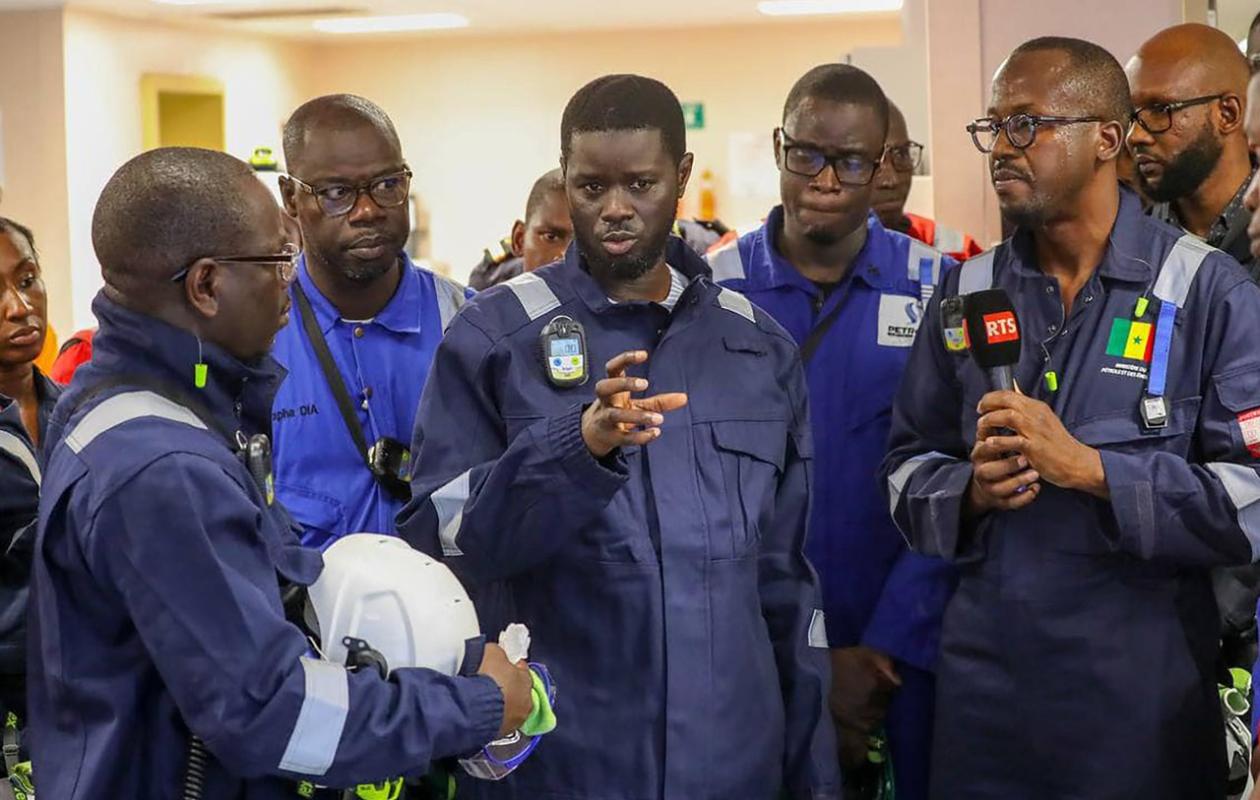
Flambée des prix du pétrole : le Sénégal face à ses faibles capacités de stockage
The price of a barrel of oil crossed the $90 mark on Friday, March 6, a level it had not reached since April 2024. In this context of war in the Middle East, Senegal wanted to take the lead in order to maintain control over the evolution of hydrocarbon prices internationally.
Prime Minister Ousmane Sonko chaired a special meeting on Tuesday, March 3, to anticipate the consequences of the soaring price of a barrel of oil. All measures will be taken, officials assured, to guarantee the continuity of the country's hydrocarbon supply.
However, despite this stated commitment, Senegal faces a major challenge: its limited storage capacity. Since a 1998 decree, the country has stipulated a storage period that barely exceeds one month.
"Every holder of an import license is required to establish a safety stock for each imported product in order to guarantee the satisfaction of the needs of the national market for a period of 35 days. This is in order to avoid supply disruptions which could harm the population and the national economy," the decree emphasizes.
Modernize (and relocate) the infrastructure
With the discovery of oil, it became apparent that storage capacity is one of the Achilles' heels of the hydrocarbon sub-sector, and more broadly of the energy sector.
"With regard to existing transport and storage infrastructure for petroleum and gas products, the Oil and Gas Master Plan has demonstrated the urgency of modernizing it, decentralizing it to the regions and adapting logistics to safety standards," emphasizes the Energy and Mining Sector Development Policy Letter (LPDSEM) 2025-2029.
According to the same document, "total storage capacities are estimated at 485,000 m³ for liquid products, of which 320,000 m³ were installed between 1932 and 1966. For liquefied petroleum gas (LPG), Senegal has approximately 18,500 tonnes of capacity."
In response to this situation, Senegal aims to increase its strategic reserve to 90 days. Plans include the construction of new infrastructure to enhance the country's capacity to withstand external shocks. An additional 321,000 m³ of storage capacity is currently under construction: 310,000 m³ at the Sendou-Bargny mineral port and 11,000 m³ at the Dakhonga-Foundiougne port.
SAR, 50% of local market needs
The State also intends to use these projects to decongest the port of Dakar. According to the document entitled "Strategic Environmental and Social Assessment (ESSA) of the oil and gas sector in Senegal" (November 2022), "it is planned to move some, if not most, of the storage capacity of the port of Dakar to the new port of Sendou-Bargny. The Senstock Mbao site is supplied with hydrocarbons from the refinery via an underground pipeline. An expansion project is underway, using land adjacent to the site already owned by SENSTOCK."
At the same time, the refining capacity of the African Refining Company (SAR) increased from 1.2 to 1.5 million tons, covering between 40% and 50% of national needs. The remaining 50% of refined products are imported by SAR and other companies.
The refinery plans to reach a capacity of 5.5 million tons through the SAR 2.0 project, in order to cover 100% of domestic market needs. However, this project cannot yet act as a stopgap measure, as its progress "was estimated at 10% in December 2024."
In summary, Senegal would struggle to cope with a prolonged rise in oil prices due to its limited petroleum product storage capacity. Several initiatives have been launched to address this situation, but for now, they remain more in the planning stages than in implementation.









![[EXCLUSIF] Affaire PCD : Le cap des 100 arrestations franchi, le téléphone d'Ass Dione accable le fils d'un grand marabout](https://image.seneweb.com/content/news/2026-20-13//thumb_1260x800_6a04a22c82a84_ACA7PLyDxC.jpg)










Commentaires (5)
Participer à la Discussion
Règles de la communauté :
💡 Astuce : Utilisez des emojis depuis votre téléphone ou le module emoji ci-dessous. Cliquez sur GIF pour ajouter un GIF animé. Collez un lien X/Twitter, TikTok ou Instagram pour l'afficher automatiquement.