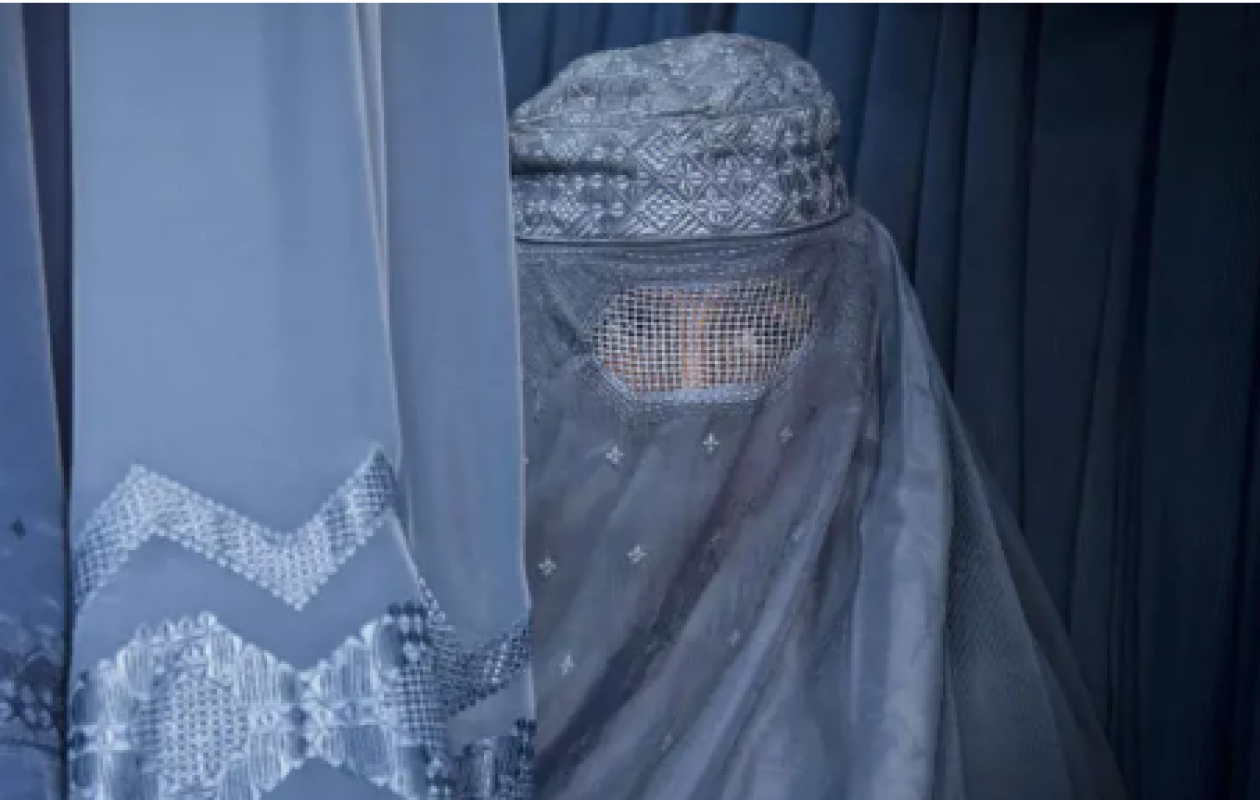
Avorter en Afghanistan : comment les femmes sont poussées à risquer leur vie
Deprived of contraception and access to healthcare, forced to have abortions in secret, Afghan women recount the risks they take to terminate unwanted pregnancies. This reality reveals the collapse of women's sexual and reproductive rights under the Taliban regime.
"If anyone finds out, we'll end up in prison." That's what Bahara, 35, told AFP when she went to a hospital in Kabul, the capital of Afghanistan, to beg for help with an abortion. In the country retaken by the Taliban in August 2021, having an abortion—or helping someone have one—is a crime punishable by imprisonment.
It was her unemployed husband who ordered this mother of four daughters to "find a solution": he didn't want a fifth daughter. Since the Taliban returned, girls have been banned from middle schools, high schools, universities, and most jobs, and therefore cost more money than they can earn.
"We can barely feed them. If it was a boy, he could have gone to school and worked," explains Bahara.
Serious obstacle to access to healthcare
Behind these clandestine abortions lies a deeply gendered and economic violence. In a country where girls are excluded from school, work, and public spaces, the birth of a daughter is perceived by some families as a financial burden. This reality directly influences women's reproductive decisions, which are often made under duress.
So on Tuesday, December 11, the People's Court for Women in Afghanistan issued a landmark ruling on the persecution of women in the country, following hearings held earlier in the year.
This ruling includes a point concerning violations of the right to health. "Since 2021, the de facto authorities in Afghanistan have imposed restrictive and discriminatory measures that severely hinder women's and girls' access to healthcare, including sexual and reproductive health."
"Miscarriages"
When they regained power in 2021, the Taliban, who follow a strict interpretation of Islamic law, did not change the law on abortion.
But they regularly check that abortions are not being performed in hospitals, causing panic among doctors and pushing women to have clandestine abortions, a dozen people working in the health sector told AFP.
Twenty years earlier, the Taliban's withdrawal from power had allowed humanitarian organizations to enter Afghanistan, enabling the provision of funds for girls' education, as well as family planning and improved birth monitoring.
"We were freer to perform abortions; there were NGOs supporting us, no government controls," a gynecologist in Kabul told AFP. "Today, doctors are afraid because if prescriptions are checked at the pharmacy, it's very dangerous. So more women try at home."
When the hospital refused to help her, Bahara ended up going to the market to buy an herbal tea made from a variety of mallow, known to induce contractions. But this abortifacient plant, if used in the wrong dosage, can damage organs and cause severe bleeding. Suffering from intense bleeding, Bahara finally returned to the hospital, pretending she had fallen to avoid being reported. "They operated on me to remove the remains of the fetus. Since then, I've felt very weak."
Speaking to AFP, other Afghan women also gave their accounts – under the condition of anonymity to protect them from reprisals by the Taliban regime, as well as by ultraconservative society. One of them swallowed a drug known to be toxic to the fetus, another recounted crushing her stomach with a heavy stone.
In 2017 (before the Taliban returned to power), a Guardian article already reported an increase in unsafe abortions in Afghanistan, disguised, according to caregivers, as "miscarriages" to avoid stigmatization or repression.
Networks like the "Pill Force" were clandestinely distributing abortion pills to help married female students continue their studies without becoming pregnant. This network illustrates that, lacking legal access, women were already organizing themselves to circumvent the prohibitions, often in dangerous and risky conditions.
Since the Taliban's return, access to contraception has become even more difficult. In February 2023, the Afghan women's media organization "Rukhshana" stated: "It is only a matter of days before access to contraceptive methods is completely banned in the provinces of Kabul and Balkh."
According to this media outlet, the Taliban allegedly ordered pharmacies to ban the sale of contraceptives, claiming that Islamic law forbids it. The Afghan government dismissed this information as "false," despite confirmation from several sources.
The following year, however, a Vanity Fair investigation revealed the contraceptive shortage faced by Afghan women since the Taliban came to power. This situation has given rise to a dangerous trade run by Pakistan, involving both counterfeit medications and pill packs sold at exorbitant prices.
According to the United Nations Department of Economic and Social Affairs (DESA), less than half of Afghan women currently have access to contraceptive methods such as condoms, implants, or the pill. "Budget cuts to health services and the forced closure of family planning clinics are jeopardizing access to modern contraception."
"I was told it would help me."
The closure or reduction of NGO-funded clinics following the withdrawal of international funding also threatens reproductive health services, further reducing access to safe pregnancy and abortion care.
The number of health facilities has been halved and only 297 of the country's approximately 400 districts, spread across 34 provinces, still have health infrastructure, laments the People's Court for Women in Afghanistan.
In April 2025, according to the same court, the number of maternal deaths was estimated at 620 per 100,000 live births, representing a 19% increase in maternal mortality.
In this country where the maternal and infant mortality rate is among the highest in the world, abortion is theoretically permitted in cases of serious danger to the pregnant woman, but in practice this right is rarely granted.
So, when asked about the issue, the spokesman for the Afghan Ministry of Health, Sharafat Zaman – who recalls that, according to the Taliban, abortion amounts to "killing a life" – replies that although the government is concerned about the conditions under which clandestine abortions are performed, it is not responsible for the "problems" encountered by some women who decide to have abortions under these conditions, insofar as the government authorizes certain terminations of pregnancy.
Despite the bans, some pharmacies still take the risk of selling abortifacient drugs without a prescription.
But while some healthcare professionals can offer the women concerned a benevolent complicity, others do not hesitate to demand exorbitant sums, in one of the poorest countries in the world.
"At four months pregnant, I discovered I was carrying another girl," Nesa, already a mother of eight daughters and one son, told AFP. "I knew if my husband found out, he would throw me out," she continued. "I begged a clinic for help. They asked for 10,000 Afghanis (130 euros), which I didn't have."
The young woman therefore obtained an antimalarial drug from a pharmacy – contraindicated during pregnancy because it is potentially toxic to the fetus. "I was told it would help me," she said.
"I started bleeding and lost consciousness. I was taken to the hospital, I begged the doctors not to report me. And they surgically removed the remains of the fetus."
Another young woman, aged 22, testifies to the clandestine abortion she underwent after having an extramarital affair – an act considered even more problematic, and which can lead to "honour killings".
"My mother contacted a midwife, but she asked for too much money. So my mother took me home, placed a very heavy stone on my stomach and crushed it."
Excluded from health centers
Public health specialists observe this phenomenon in all countries where abortion is criminalized: women do not have fewer abortions, but they do so under riskier conditions. The WHO estimates that unsafe abortions are responsible for 39,000 to 47,000 maternal deaths each year worldwide, primarily in countries where access to abortion is restricted.
Only 34% of women of reproductive age live in countries where abortion is permitted on simple request (which represents only 77 countries in total), recalls the NGO Center for Reproductive Rights (CRR).
In Afghanistan, it is the collapse of the health system, combined with the repression of women, that makes these practices particularly dangerous.
"Women have been barred from accessing health centers without the presence of a mahram (male guardian); restrictions have been imposed on the ability of female health professionals to practice; directives have been issued requiring medical universities to exclude women from medical studies; and women are discouraged from enrolling in institutes offering training in midwifery, nursing, radiology, or dentistry," the People's Court for Women in Afghanistan denounced in its judgment on Tuesday, referring to women suffering or dying from preventable diseases.
A year ago, Heather Barr, deputy director of the Women's Rights division at Human Rights Watch (HRW), had already warned: "If women are forbidden from being treated by male health professionals, and then forbidden from training to become health professionals, the consequences are clear: women will not have access to health care and will die."
Thus, in Afghanistan, clandestine abortion is neither an individual choice nor an isolated transgression, but the product of a system that excludes women from school, work and care, and forces them to put their health – sometimes even their lives – at risk in order to regain a minimum of control over their bodies.

















Commentaires (1)
Participer à la Discussion
Règles de la communauté :
💡 Astuce : Utilisez des emojis depuis votre téléphone ou le module emoji ci-dessous. Cliquez sur GIF pour ajouter un GIF animé. Collez un lien X/Twitter, TikTok ou Instagram pour l'afficher automatiquement.