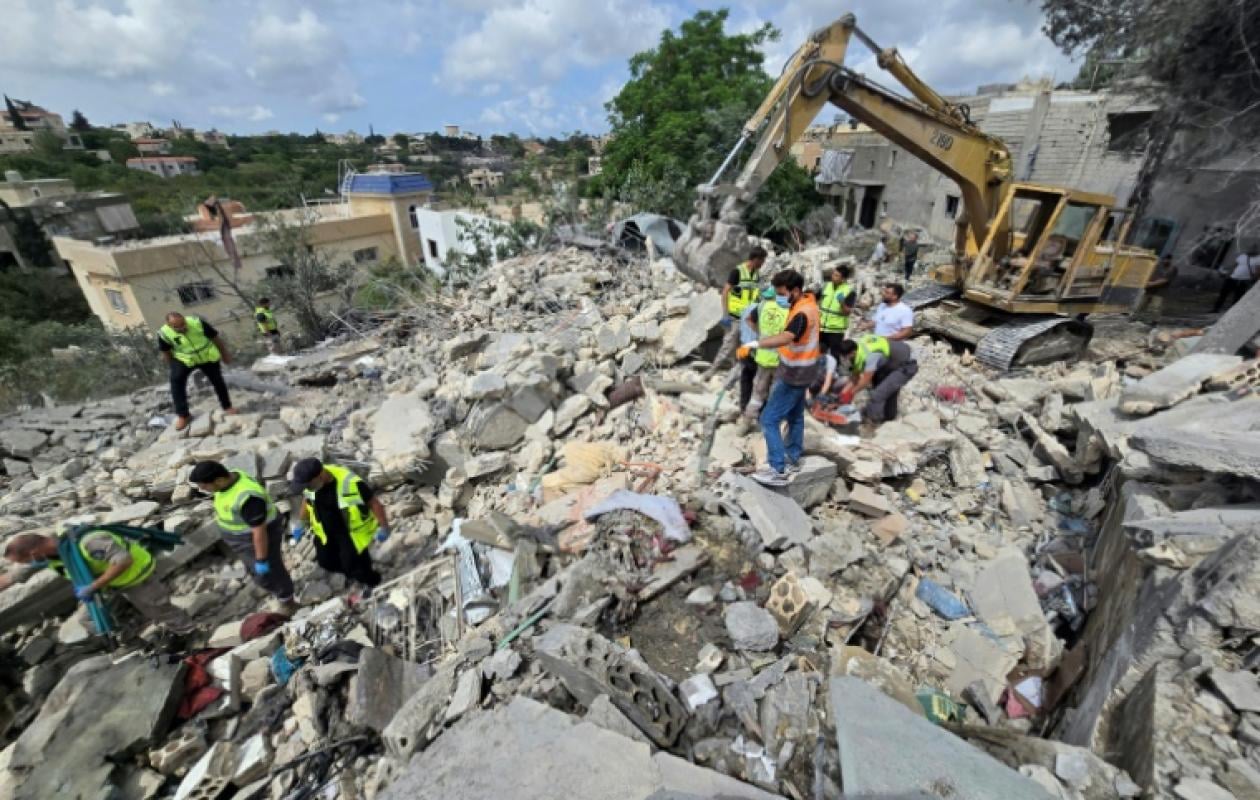
Dans le sud du Liban, Israël accusé de rayer des villages de la carte
For weeks, Hala Farah has been collecting all the images and videos she can find of her village to preserve its memory: Yaroun was completely destroyed by Israel, like dozens of other localities in southern Lebanon.
Satellite images and photos taken by AFP in the region, as well as testimonies from displaced residents and officials, report destruction of unprecedented scale.
Lebanese authorities accuse Israel of committing a veritable "urbicide" in the south of the country, a military strategy aimed at obliterating cities.
They have documented more than 50,000 buildings destroyed or damaged since the start of the war between Israel and the pro-Iranian Hezbollah on March 2, as well as some 56,000 hectares of agricultural land.
Schools, places of worship, vital infrastructure: the destruction spared nothing, in areas occupied by Israel as well as in those it is intensively shelling.
"Everything has been destroyed, all we have left are memories and photos that we are trying to compile with the neighbors to preserve our memory, and to be able to tell our children what Yaroun was like," says Hala Farah.
It was with the help of satellite images that this 33-year-old woman, displaced in northern Beirut, saw her house reduced to ruins two weeks ago.
"I hoped to see my daughters grow up in the family home (...) but the war took everything from us," she adds, sporting on her black T-shirt a pin bearing the image of her village, very close to the border with Israel, where Christians and Muslims lived.
Some displaced people from areas off-limits to the Israeli army are pooling their resources to buy satellite images, at a price of $140 each.
Social media is full of images of buildings before and after their destruction: an anti-Hezbollah activist misses his grandfather's three-story house in Nabatiyeh, a seasoned writer mourns his library in Bint Jbeil, and an internet user laments the loss of the city's mosque, whose stones, which had remained intact for four centuries, were pulverized by strikes.
"Israel is trying to take away all the vital resources from us upon our return," Hala Farah asserts, inconsolable.
The continued destruction after the truce came into effect on April 17 "confirms the Israeli plan of urbicide throughout the south," she says, scrolling through photos and videos on her mobile phone.
The operations targeted "the parish hall, a convent of nuns and the Saint-Georges school (...). There were certainly no trenches or weapons" under these buildings, she protested.
The Israeli army says it is targeting Hezbollah military objectives and infrastructure.
Much of Yaroun already appeared destroyed in early 2025, following the previous war, according to an AFP image analysis. In the May 2026 images, the areas that had remained standing are now obliterated.
In Bint Jbeil, about six km from the border, no major destruction appeared on satellite images in early April 2026.
Barely a month later, almost the entire city was razed, including its stadium where former Hezbollah leader Hassan Nasrallah had delivered an iconic speech in 2000, after the Israeli withdrawal.
"Most of the buildings in Bint Jbeil have been destroyed," Chadi Abdallah, secretary general of the National Council for Scientific Research (CNRS), confirmed to AFP, projecting images onto a giant screen.
According to him, "most of the mining and demolition operations using explosives" took place during the truce. "The Israelis are destroying the land, the people, and the stone."
"They are trying to uproot populations from their land, to erase the memory of the inhabitants and to erase their history," continues the expert, whose team is working day and night to assess the impact of Israeli actions.
According to a study by the Lebanese CNRS, Israeli attacks in the south have destroyed and damaged more than 290,000 homes since the last war in 2023. This includes 61,000 since March and 12,000 during the truce.
"This is the first time in its history that Lebanon has experienced such destruction," says researcher Hana Jaber, originally from Bint Jbeil, as the strikes have left more than 3,000 dead.
The displaced people, who number over a million and are mostly Shiites, are experiencing "a displacement (...) which will have terrible consequences," she believes.
Among them, Imad Bazzi, a 60-year-old engineer, laments the recent destruction of his company's headquarters in Bint Jbeil.
Residential buildings, water and electricity networks, hospital, schools and gas stations: "it's a clear geographical shift, a systematic destruction," describes this city councilor.
The city was more than 75% destroyed, equivalent to 4,000 housing units, according to his estimates.
Israel, whose soldiers operate within a perimeter delimited by a "yellow line", located 10 km from the border, claims to want to protect its population from Hezbollah threats.
Lebanon and Israel have begun direct negotiations, the first in decades, despite Hezbollah's opposition, which Hala Farah hopes will succeed.
She says she is determined to rebuild her village. "We hope this war will be the last, because our villages in the south are currently dying," she says.
"We hope that Israel will withdraw from every part of our land and let us (...) create new memories for our children."
AFP



















Commentaires (2)
Participer à la Discussion
Règles de la communauté :
💡 Astuce : Utilisez des emojis depuis votre téléphone ou le module emoji ci-dessous. Cliquez sur GIF pour ajouter un GIF animé. Collez un lien X/Twitter, TikTok ou Instagram pour l'afficher automatiquement.