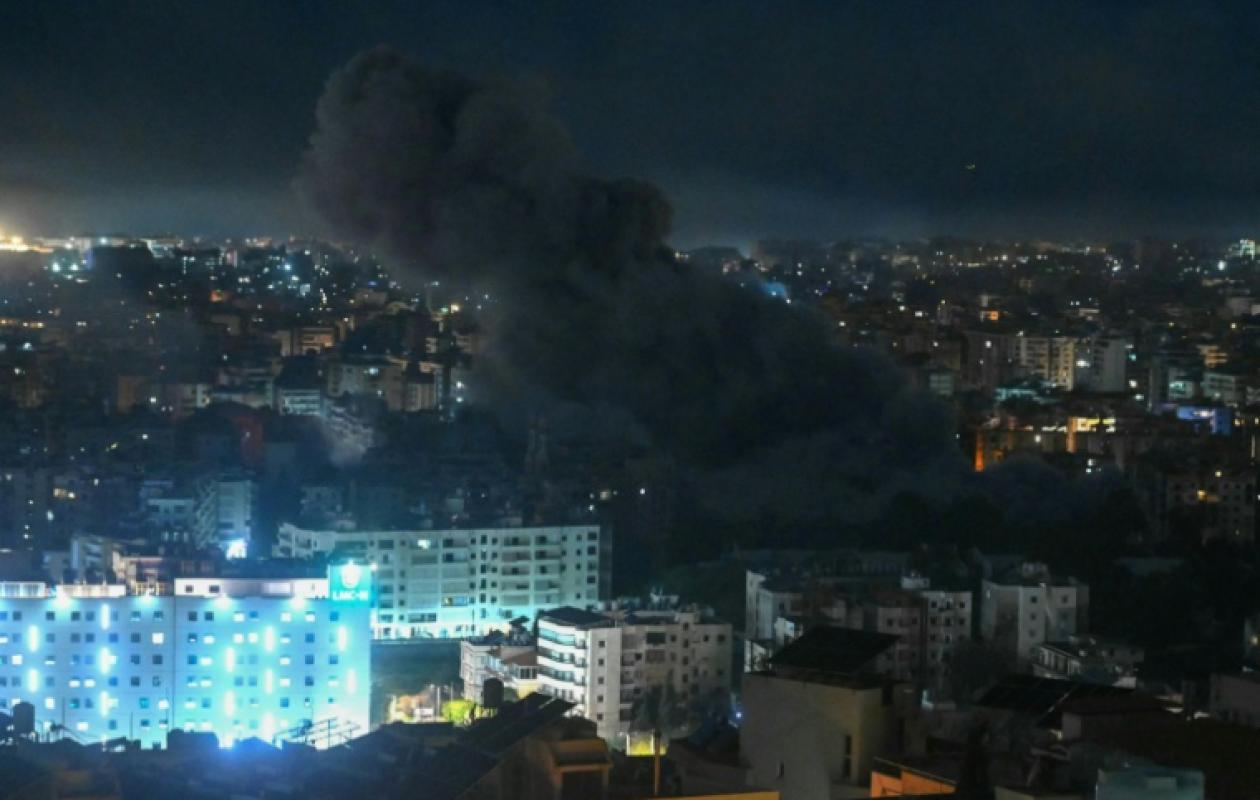
Frappes sur les infrastructures iraniennes, Israël annonce un durcissement
Beirut and Tehran awoke Friday to airstrikes, as part of a new phase of the war promised by Israel, now focused on the infrastructure of the Iranian regime and the stronghold of its ally, the Lebanese Hezbollah.
AFPTV images from southern Beirut showed buildings completely gutted and vehicles burned out after overnight Israeli bombings, while tens of thousands of people fled the destruction.
The American-Israeli war against the Islamic Republic, which is entering its seventh day, is engulfing the Middle East and is causing even more concern among global economic players as its duration proves to be highly uncertain.
Sending ground troops to Iran would be a "waste of time," as the Iranians have already "lost everything they could lose," Donald Trump told NBC News.
His Defense Minister Pete Hegseth, however, ruled out a quick resolution, stating: "we are only at the beginning of the fighting".
During the night, Israeli fighter jets targeted several locations in southern Lebanon as well as the outskirts of Baalbek (east), according to the national news agency.
The Israeli army has been ordered to advance further into southern Lebanon in order to extend its zone of control to the border.
Israel Raziel, a 64-year-old retired taxi driver, has known about rocket alerts since the 1970s, a time when air defenses were almost non-existent.
He wants to hope that this war will be the last. "I think it has to end," he told AFP. But the prospects for that are slim and the immediate future terrifying.
On Thursday, a real panic gripped Beirut after an unprecedented call from Israel to evacuate the southern suburbs of the capital, a Hezbollah stronghold where massive traffic jams immediately formed.
In the evening, the area was hit by several strikes, including one "very violent" according to the Ani news agency, which indicated that the suburb had "almost emptied" after "a massive exodus".
In Iran, Israel launched a series of "large-scale" strikes on the capital. Iranian media, including the national broadcaster IRIB, reported early Friday a series of explosions in various parts of the capital, particularly in the east and west.
The Revolutionary Guards, the ideological army of the regime, announced in response "a combined missile and drone attack, as well as the launch of a barrage of Kheibar missiles, targeting locations in the heart of Tel Aviv".
The bustling Israeli city is constantly under attack. A series of about eight explosions was heard there on Friday morning, following an alert about Iranian missiles, AFP journalists reported.
Israeli emergency services Magen David Adom stated that no casualties had been reported at this stage.
The third front, essentially the Gulf countries hosting American military bases, also testified to the maintenance, on the seventh day of the war, of the Iranian strike force.
Saudi Arabia and Qatar both announced early Friday that they had thwarted drone and missile attacks targeting air bases. In Bahrain, a hotel and several buildings were hit.
For the time being, neither side is inclined to discuss the matter.
On Thursday evening, Donald Trump demanded "to be involved" in the choice of successor to Ali Khamenei, the Iranian supreme leader killed in a strike in the early hours of the war, dismissing the idea that his son could be chosen.
Israel claims to have destroyed more than 60% of Iran's ballistic missile launchers and 80% of its anti-aircraft defenses, following 2,500 strikes using more than 6,000 munitions. The country asserts "near-total air superiority in Iranian airspace."
Iranian Foreign Minister Abbas Araghchi, for his part, reaffirmed Tehran's determination, with the formula neither "ceasefire" nor "negotiations".
Increasingly isolated, the Islamic Republic can now only rely on weakened allies.
The Houthis of Yemen, pro-Iranian rebels who have remained silent since the beginning of the war, have "their finger on the trigger" and are "ready to respond at any moment," their leader Abdul Malik al-Houthi assured.
Diplomacy, for the time being, remains the prerogative of third countries.
"Everything must be done" to prevent Lebanon "from being drawn back into war," urged French President Emmanuel Macron, responding to a call to that effect from his Lebanese counterpart Joseph Aoun.
The Lebanese Ministry of Health announced Thursday evening that at least 123 people have been killed and 683 wounded since Monday. Its Iranian counterpart reported 926 deaths to the IRNA news agency, a figure lower than some other official sources.
Thirteen people, including seven civilians, have been killed in the Gulf countries, among them an 11-year-old girl in Kuwait. In Israel, the death toll stands at at least 10.
AFP is unable to independently verify these figures.



![[EXCLUSIF] Kaolack : Un vigile de banque et un fils de notable à la tête d'un réseau d'actes contre nature sur des mineurs](https://image.seneweb.com/content/news/2026-17-24//thumb_1260x800_69ebcedead0ea_Zz76TxOZR9.jpeg)









Commentaires (6)
Participer à la Discussion
Règles de la communauté :
💡 Astuce : Utilisez des emojis depuis votre téléphone ou le module emoji ci-dessous. Cliquez sur GIF pour ajouter un GIF animé. Collez un lien X/Twitter, TikTok ou Instagram pour l'afficher automatiquement.