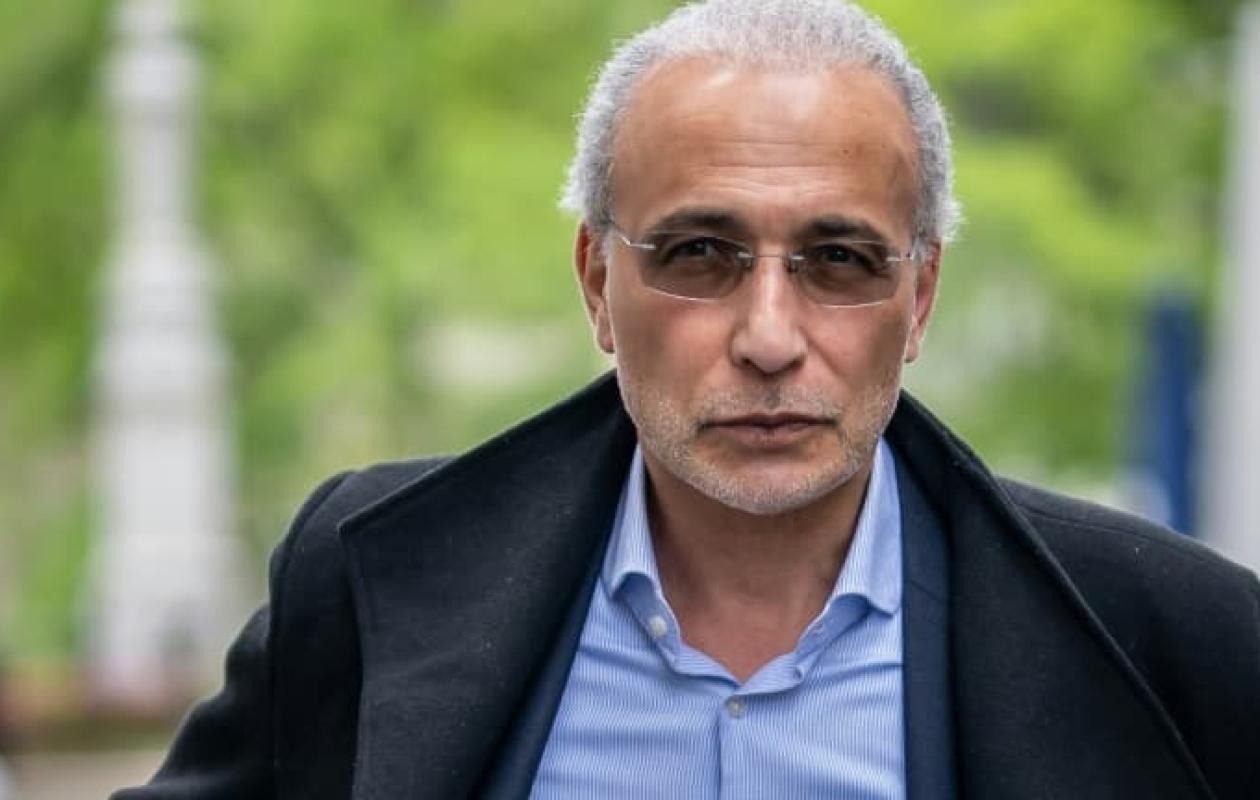
Procès de Tariq Ramadan : l’islamologue condamné par défaut à 18 ans de prison pour viols
The preacher, who never appeared in court during the three weeks of hearings, was found guilty of raping the three complainants.
The dock remained consistently empty. Since March 2nd, Tariq Ramadan had been tried in absentia by the Paris Criminal Court for the rapes of three women, charges he vehemently denies. Citing his deteriorating health—the Islamic scholar suffers from multiple sclerosis—he allowed the proceedings to continue without him until the verdict was delivered this Wednesday. The judges found him guilty of raping three women and sentenced him in absentia to 18 years' imprisonment, in accordance with the prosecution's request.
The court ordered that he be subject to judicial supervision for eight years, prohibiting him from contacting the victims and from publishing any work, audiovisual production, or public statement relating to this offense. It also sentenced him to a permanent ban from French territory once he has served his sentence.
This decision brings to a close three weeks of a "senseless" trial, marked by delaying tactics from the defense, according to the lawyers for the plaintiffs. From the very first day, Tariq Ramadan's four lawyers explained that he had been hospitalized earlier in Switzerland—despite his judicial supervision prohibiting him from leaving France—due to a "flare-up" of multiple sclerosis. To support this claim, they submitted a medical certificate describing him as "drained of his vital energy" and requiring "a rest period of one to ten days." This unexpected announcement immediately raised the question of whether the trial would be postponed to a later date when he would be fit to appear. David-Olivier Kaminski, the lawyer for one of the victims, immediately saw this as an attempt "to evade the debate." "Let's not kid ourselves, Tariq Ramadan is using every means to avoid appearing and to avoid being tried," added the public prosecutor.
A "travesty of justice"
In these circumstances, the criminal court ordered a medical examination by two neurologists. Four days later, on March 6, the verdict was delivered: the doctors determined that the preacher was fit to stand trial. In their report, read aloud in court by presiding judge Corinne Goetzmann, the neurologists concluded that the multiple sclerosis from which the Islamic scholar had suffered for several years was stable, with no signs of a recent flare-up. The judge therefore decided to try the 63-year-old defendant in absentia and behind closed doors, as requested by one of the civil parties. She also issued an arrest warrant for him, with immediate execution and dissemination.
In response to this decision, his lawyers – Marie Burguburu, Sarah May Vogelhut, Nabila Asmane, and Ouadie Elhamamouchi – denounced it as a “travesty of justice” and stormed out of the courtroom in a dramatic turn of events. “Do we have any other choice but to leave?” one of them, Ouadie, told reporters.
Elhamamouchi added: "Tariq, once again, is the target of judicial harassment." From then on, the days of hearings followed one after another, deprived of the defense's explanations, which are nevertheless essential for a fair trial. This situation was perceived as a slap in the face by the plaintiffs, who had been awaiting this trial for over 15 years after the events in one case. "It's yet another way of showing contempt for the authorities and the victims," lamented criminal lawyer Sarah Mauger-Poliak.
On Tuesday, March 24, yet another twist surprised the civil parties: new defense lawyers submitted a medical certificate to the court indicating the defendant's impending psychiatric hospitalization, without this affecting the course of the hearing. "Day after day, the overwhelming evidence of his guilt accumulates. This morning, Mr. Ramadan attempted a last-ditch maneuver, which backfired, to escape his serious and grave criminal responsibilities," commented Mr. David-Olivier Kaminski.
"The madman's gaze and the words of domination"
Tariq Ramadan, a controversial figure in European Islam, has been sent to trial after an eight-year investigation for the rape of three women: a violent rape of Christelle in Lyon in October 2009; another rape in 2012 in Paris of Henda Ayari, a former Salafist turned secular activist who triggered the case by filing a complaint in October 2017; and a final rape in 2016 of a third woman. Initially,
The investigating judges had also sent him to trial for similar acts against a fourth complainant, Mounia Rabbouj, but the appeals court, seized by the Islamic scholar, ultimately dismissed her case. It also rejected the notion of "undue influence" that permeated the case, ruling that this concept, "in the sense of a stratagem resulting in the necessarily total deprivation of free will," could not be applied to the relationship between Tariq Ramadan and the plaintiffs.
For the Court of Appeal, on the contrary, "violence is the primary focus in the various accounts" of the victims. The plaintiffs described particularly brutal sexual relations, summarized by the investigating judges in their ruling as follows: "The hand that holds and forces the head, the arm that prevents movement or turning over, the weight of the body, the crazed look, the words of domination and submission, the orders, the gestures, this attitude used to impose penetration." The preacher initially vehemently denied any sexual relations with these women before finally admitting to the existence of adulterous relationships, marked by "domination," rough but "consensual"—a major turning point in this case.
Following the investigation, he launched numerous procedural attacks to demand a resumption of the investigation and postpone the trial, claiming to possess new expert reports that, according to him, proved his innocence. His lawyers argued that over the past year, their client had filed "no fewer than five motions to submit essential new evidence," but had been met with "silence" from the presiding judge of the criminal court. While Tariq Ramadan continues to cry foul, alleging a judicial conspiracy, the civil party's lawyer, Ms. Mauger-Poliak, insisted at the start of the hearing: "This trial is neither a conspiracy nor a political battle, but the sadly ordinary story of the rape of three women under his control."
In September 2024, the controversial Islamic scholar was sentenced in Switzerland to three years in prison, one of which was suspended, for similar offenses related to the rape of a woman in a Geneva hotel in 2008. There too, Tariq Ramadan has launched a series of appeals, announcing his intention to take his case to the European Court of Human Rights (ECHR) and also filing a request for a retrial, which is currently being processed according to the Geneva judicial authorities.





![[EXCLUSIF] Expulsion de la famille Srour : L'accusée Khady Diagne se prononce, documents à l'appui](https://image.seneweb.com/content/news/2026-20-14//thumb_1260x800_6a05cc2715573_a9nMMiStMC.jpg)










Commentaires (9)
Participer à la Discussion
Règles de la communauté :
💡 Astuce : Utilisez des emojis depuis votre téléphone ou le module emoji ci-dessous. Cliquez sur GIF pour ajouter un GIF animé. Collez un lien X/Twitter, TikTok ou Instagram pour l'afficher automatiquement.