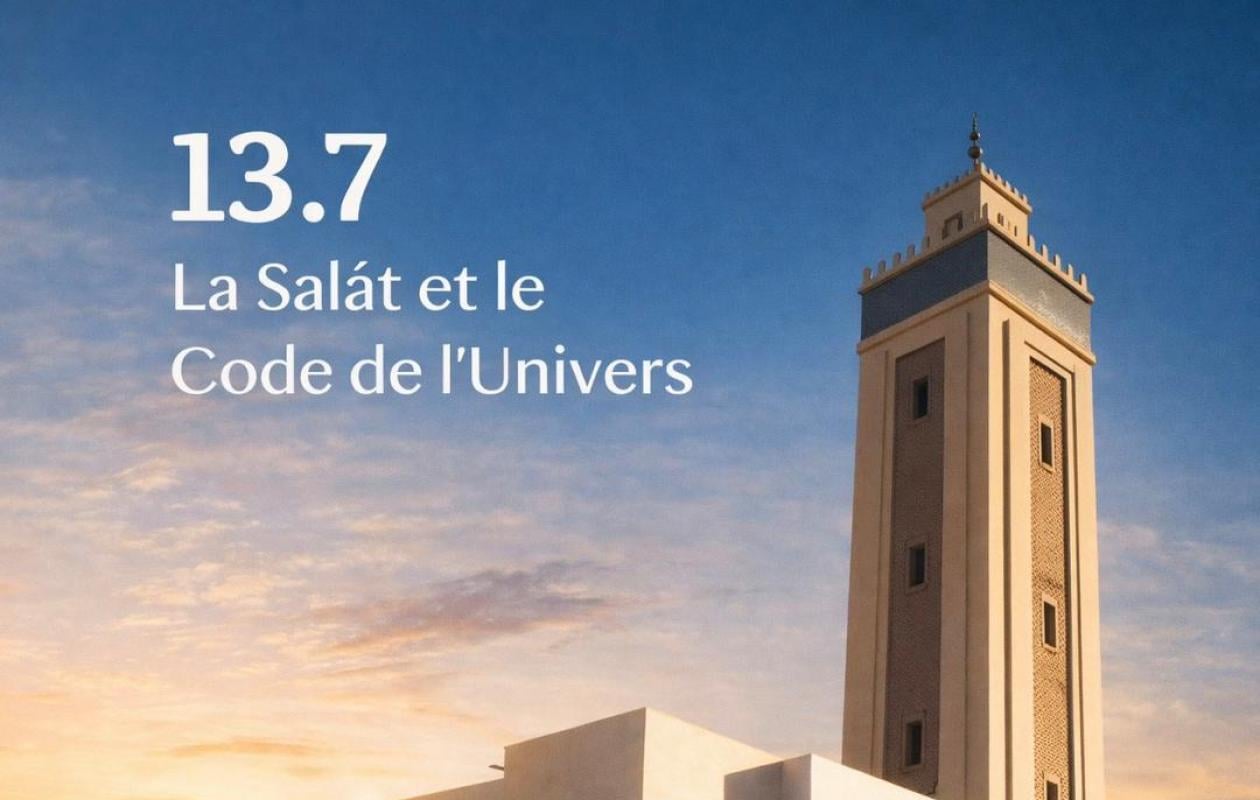
Le code de l’univers révélé dans la Salāt, la prière musulmane
By the grace of Allah, in our previous article, we were able to see how the mysteries of Salat encrypt a table of correspondence which establishes a close link between Salat, the verses of the Quran relating to its revelation, as well as the verses of the miracles of the Table served (of Jesus) and the end of Abu Lahab.
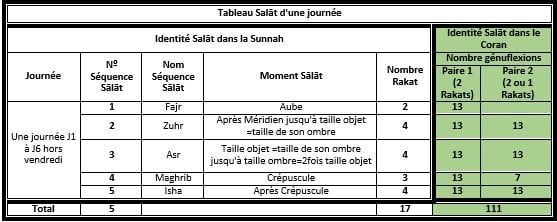
Let us now look at what we might call the "DNA code" of Salat, that is, its identity within the Quran (indicated in green in the table above). We have seen that, during the Meccan period (13 years), only the first pair of rak'ahs was obligatory. The second pair was added later, after the Hijra.
However, the Fajr (dawn) and Maghrib (sunset) prayers, which mark the transition between night and day, have remained unchanged since the beginning. We can therefore see that the genuflections (bowing and prostrations) form a kind of simple code based on two values: 13 and 7. This pattern is found in almost all prayers, with the exception of the Fajr and Maghrib prayers, which remain unique.
Therefore, as with digital information, genuflections convey a message that the Quran allows us to decipher. Pair 1, constant in all Salat, is assigned to the surahs, which are also of equal importance. Pair 2, which varies in its values and according to the sedentary nature of the worshipper, is assigned to the verses, the number of which also varies according to the surahs. Thus, we have:
1. Salat Fajr : Surah 13 Ar-Rad (The Thunder); verse 0 : In the Name of Allah, the Most Gracious, the Most Merciful
2. Salat Zuhr, Asr, Isha : Surah 13 Ar-Rad (The Thunder); verse 13 : " The thunder glorifies Him with praise, and so do the angels, out of fear of Him. And He sends thunderbolts with which He strikes whom He wills. But they dispute about Allah while He is awesome in power."
3. Maghrib Prayer: Surah 13 Ar-Ra'd (The Thunder); verse 7 : "And those who disbelieve say, 'Why has a sign not been sent down to this one (Muhammad) from his Lord?' You are only a warner, and for every people is a guide."
All the messages in the Salat sequences refer to the worship of Allah:
. Surah 13 verse 0: the Basmalah (In the name of Allah, the Most Gracious, the Most Merciful), which refers to the Fatiha — obligatory in every Salat — and which it is recommended to pronounce at the beginning of any action.
. Surah 13 verse 13: Worship by the physical universe, represented by thunder (rain, life), and by the spiritual universe, represented by the Angels.
The Maghrib prayer is an exception : Surah 13, verse 7, explains that disbelievers demand miracles, whereas, simply by observing the visible nature and the message of the Quran conveyed by the angels, they should recognize Allah's power and submit. However, it must be noted that Maghrib is a special time, the time of entering the night and returning to Allah. The Quran tells us, Surah 6, Al-An'am, verse 60: "And it is He (Allah) who takes your souls by night and knows what you earned by day. Then He raises you up by day to fulfill a specified term. Then to Him is your return, and He will inform you of what you used to do."
So twilight is a time of return. That's why, instead of reading Surah 13 verse 7, if we read Surah 7 verse 31 backwards, we get a verse directly related to prayer and the worship of Allah: “O Children of Adam, take your adornment (your clothes) at every place of prayer, and eat and drink, but do not be excessive. Indeed, He [Allah] does not like those who commit excess.” (7:31 )
Twilight carries a double message: a warning and a guide to the successful return to Allah through Salat.
The decoded message of Salat is therefore:
In the Name of Allah, the Most Gracious, the Most Merciful
"O Children of Adam, take your adornment (your clothes) at every place of prayer, and eat and drink, but do not be excessive. Indeed, He [Allah] does not like those who commit excess." ( Quran 7:31)
“And those who disbelieve say, ‘Why has a sign not been sent down to this one (Muhammad) from his Lord?’ You are only a warner, and for every people is a guide.” ( Quran 13:7 )
“ The thunder glorifies Him with praise, and so do the angels, out of awe of Him. And He sends thunderbolts with which He strikes whom He wills. Yet they dispute about Allah while He is awesome in power.” (Quran 13:13 )
13.7 — This is the code of the universe (estimated today to be 13.7 billion years old): its very essence is the worship of Allah with fear and devotion. The physical and spiritual universes submit to it. Man, however, possesses free will to submit to it or not, until the inevitable Hour.
Bilal At-Tawbah
Bakary Boloba COLY
Find us at www.at-tawbah.org






















Commentaires (10)
Participer à la Discussion
Règles de la communauté :
💡 Astuce : Utilisez des emojis depuis votre téléphone ou le module emoji ci-dessous. Cliquez sur GIF pour ajouter un GIF animé. Collez un lien X/Twitter, TikTok ou Instagram pour l'afficher automatiquement.