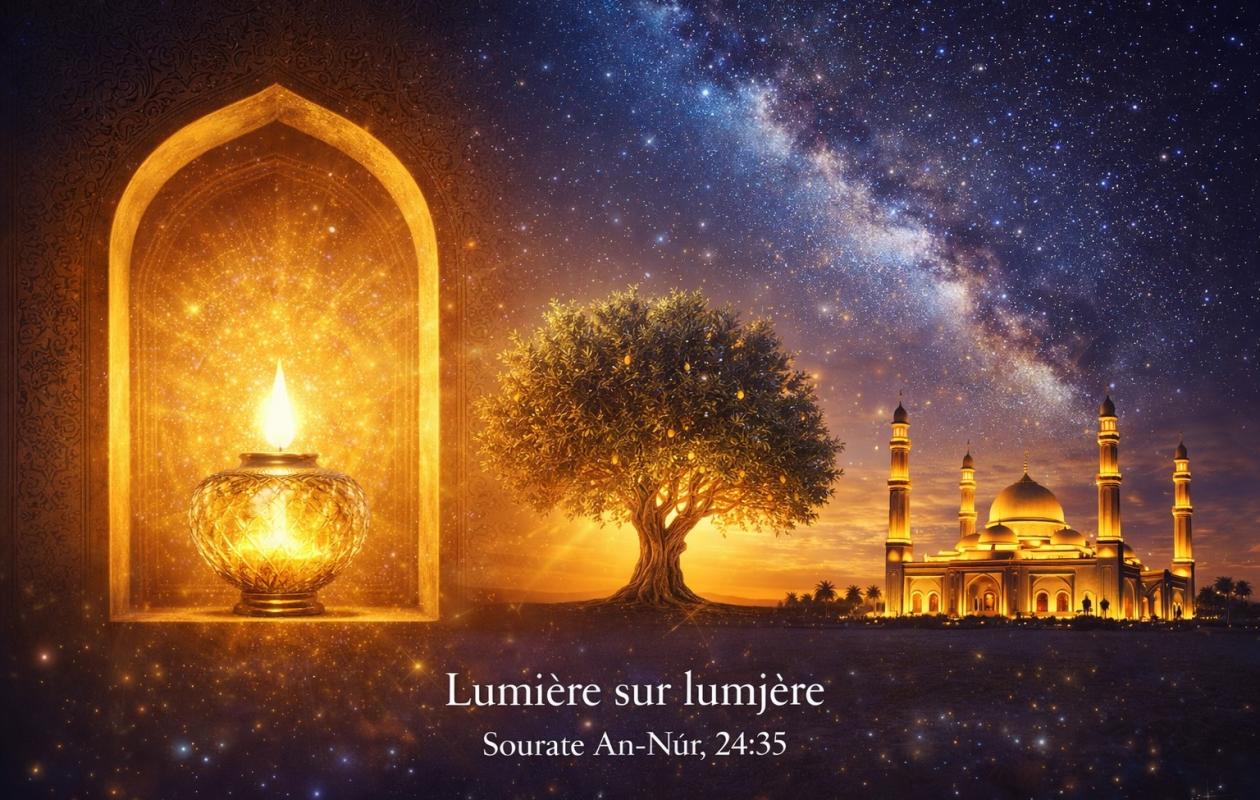
Quand le rêve de Youssouf éclaire la nature humaine
Our cousins, the stars
Through the prophetic dream of Joseph, the Quran offers us much more than a narrative: a profound key to understanding human nature. The sun, moon, and stars are not merely celestial elements, but can be understood as symbols of a broader spiritual reality.
“When Joseph said to his father, ‘O my father, I saw [in a dream] eleven stars, and the sun and the moon; I saw them prostrating before me.’” (Quran 12:4)
Later, the meaning of this vision was fulfilled:
“And he raised his parents upon the throne, and they all fell down before him in prostration. And he said, ‘O my father, this is the interpretation of my dream of long ago. Allah has indeed fulfilled it…’” (Quran 12:100)
This true dream can be interpreted as a symbolic representation:
Applied to Islam, Youssouf's dream illuminates humanity with a new light.
The Prophet Muhammad (peace and blessings be upon him) is like the Sun, bearer of divine light. This image sheds new light on the role of his family and companions. For, like the moon in relation to the sun, they have entered into a covenant with the Prophet (peace and blessings be upon him) — a bay'a of loyalty, commitment, and transmission.
Thus, the prophetic light does not disappear: it continues, reflected and carried by those who have pledged allegiance to it. The Companions, like the moon, do not all reflect this light with the same intensity. Like the phases of the crescent moon, they manifest varying degrees: sometimes subtle like a thin crescent, sometimes radiant like a full moon. The most eminent among them—Abu Bakr, Umar, Uthman, and Ali—appear like full moons, illuminating the night with exceptional clarity.
As for humans in general, like the stars, they do not all shine with the same intensity. Some gaze upon each other and guide travelers: they evoke those exceptional men and women — scholars, pious, awliya' — whose hearts are illuminated and who, in turn, become beacons in the moonless nights.
The Quran itself sheds light on this mystery: “(35) Allah is the Light of the heavens and the earth. The example of His light is like a niche within which is a lamp. The lamp is within a glass, the glass as if it were a shining star, lit from a blessed olive tree, neither of the east nor of the west, whose oil would almost glow even if untouched by fire. Light upon light. Allah guides to His light whom He wills. And Allah presents parables for mankind, and Allah is Knowing of all things. (36) In houses [mosques] which Allah has permitted to be raised and in which His name is mentioned, glorifying Him therein morning and afternoon, (37) are men whom neither trade nor commerce distracts from the remembrance of Allah and from establishing prayer and giving zakah. And they fear a Day when hearts and eyes will be overturned.” "(Surah An-Nur, 24:35-37)
Divine light does not merely illuminate the world; it dwells in the hearts that turn towards it. Those who pray, who give, who remember Allah become, in their own way, stars in the human night.
Conversely, when this light withdraws, the heart darkens. The cosmic image helps us here once again: some massive stars, at the end of their lives, collapse in on themselves and become zones of total absorption, where even light cannot persist. In the same way, a heart deprived of light can draw other hearts into its darkness. This is why the Quran calls for clarity of position: “To you your religion, and to me my religion.” (Surah Al-Kafirun) . Not in a spirit of rupture, but of lucidity: preserving one's light requires vigilance.
Therefore, a question arises: what if humans themselves were earthly stars? What if, from the heavens, angels contemplated humanity as we contemplate the night sky—distinguishing luminous hearts from those plunged in shadow? Becoming an earthly star is not a privilege reserved for a select few: it is a possibility offered to everyone, simply through the Quran, Salat, and Zakat .
Dear readers, for several weeks now we have been exploring together the miracle that is Salat. Our beloved Prophet (PBUH) conveyed a complete message, faithfully carried by his companions and then by the scholars.
For my part, like you, I am but an aspirant to becoming a star on Earth. By the grace of Allah, I have glimpsed that the unseen (ghayb) is not an abstract reality: it is a dimension that transcends our senses, yet illuminates our lives. Allah has not left us alone to face this immensity. He has given us points of reference: the Quran, prayer (Salat), mosques, and sincere repentance as the ultimate return .
As we know, the Quran is like the light of the sun: it can blind anyone who gazes upon it unprepared. And if a layperson contemplates the sun with ease, it may be because it has already entered twilight. The Sunnah speaks of the sunrise in the west as the ultimate sign marking the end of the time for repentance. In book 13.7 — The Code of the Universe Encrypted in Muslim Prayer: Salat , I propose a symbolic reading according to which the great prophets — the ulul 'azm — can be understood as successive dawns for humanity.
From this perspective, the return of ʿĪsā (Jesus), peace be upon him, can be seen as a singular movement: that of a light retracing its steps. An image which, without claiming doctrinal equivalence, can be compared to the symbol of the sun rising in the West—a figure of ultimate reversal.
Bright star or fading star, there is still time to return to the light through repentance. For the Quran calls to the light: “O you who have believed , repent!” " To Allah , sincere repentance."
Bilal At-Tawbah
Bakary Boloba COLY
Find us at www.at-tawbah.org

















Commentaires (3)
Participer à la Discussion
Règles de la communauté :
💡 Astuce : Utilisez des emojis depuis votre téléphone ou le module emoji ci-dessous. Cliquez sur GIF pour ajouter un GIF animé. Collez un lien X/Twitter, TikTok ou Instagram pour l'afficher automatiquement.