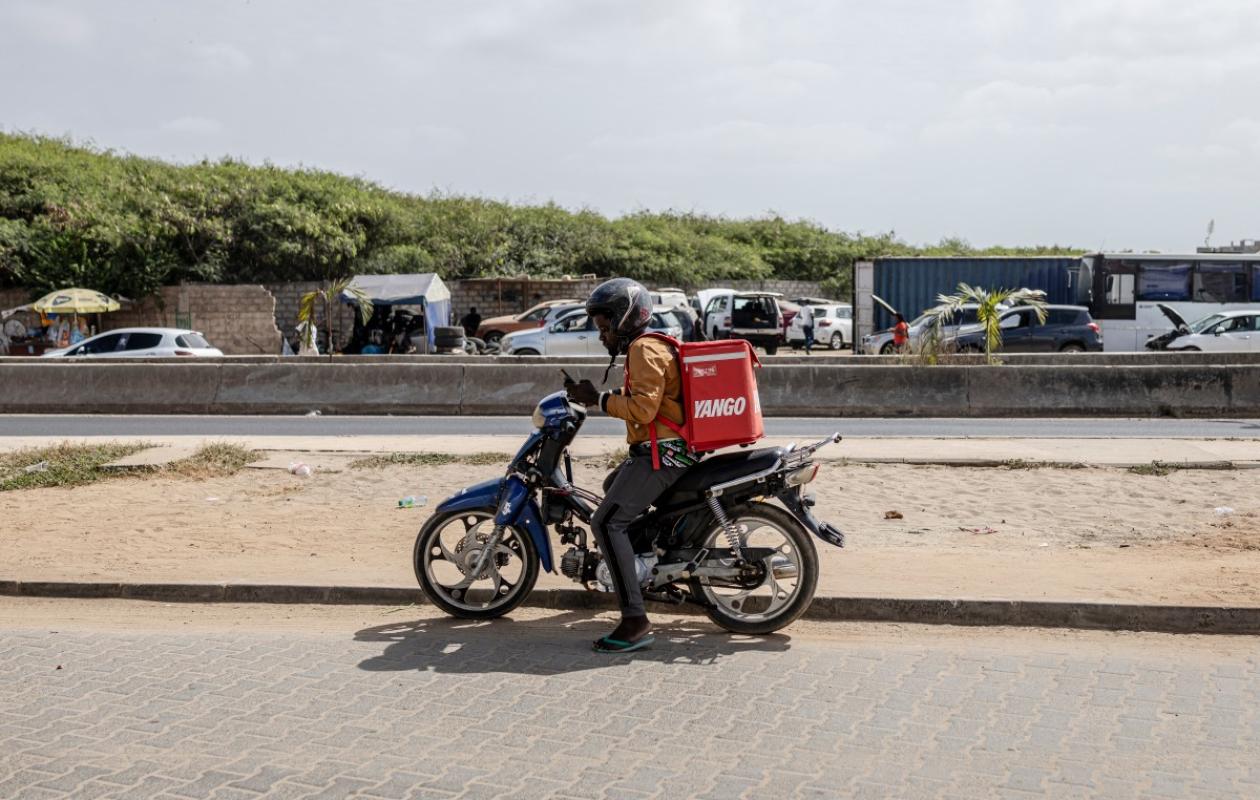
Quand les chantiers s'arrêtent et la crise s'installe, les jeunes se tournent vers les plateformes VTC
One September evening, the two wide lanes of Dakar's Corniche are, as often happens, clogged with endless lines of taxis, where hurried motorcyclists weave through the traffic. Mouhamadou Bamba, 43, tries to remain calm behind the wheel of his car while glancing at the Yango on-demand transport app displayed on his phone.
For the past two months, this civil engineer by training has joined, like thousands of other Senegalese, this digital platform similar to Uber in Europe, and launched at the end of 2021 in Senegal in the cities of Dakar, Thiès and Mbour.
For many, this is a temporary career change, while waiting for the major construction projects to resume.
Since the arrival in power of the tandem Bassirou Diomaye Faye and Ousmane Sonko in 2024, the executive branch has stopped a number of construction projects, both public and private.
On Dakar's Corniche, piles of rubble spoil the ocean view, remnants of an urban development project that was intended to stretch for some ten kilometers. Officially, the government claims it wants to "review land allocation procedures and combat coastal land grabbing."
In Diamniadio, a new city located about thirty kilometers from Dakar and considered by the former regime as the cornerstone of its policy to decongest the capital, public works projects are also at a standstill.
Thousands of workers found themselves unemployed.
The union of the Consortium of Building and Public Works Companies of Senegal (CDE) held a press conference in September to warn about the crisis in the sector.
"Salary arrears"
"As early as 2023, we started to accumulate salary delays and, since 2024, it is now 4 to 5 months of arrears," denounces Souleymane Abdoulaye Demba, union member and stock manager at CDE.
"In 2023, the Consortium still employed 2,500 workers (...) Today, we are only 1,000 left," laments Amath Diop, another union member.
Revenue in the construction sector fell by 13.4% in 2025, according to official data.
It is in this context that platforms like Yango are experiencing spectacular growth. "Since our launch, the number of partner drivers has increased approximately fourfold," estimates Sabine Djokoto-Ayité, head of public relations for Francophone Africa at the platform.
She specifies that these drivers "number in the tens of thousands". "A large proportion of the partner drivers and couriers are in the 20 to 40 age bracket", she says.
Mouhamadou Bamba is very bitter about the sector's slump. He had to change careers after the construction of a building in the upscale Almadies district of Dakar was halted.
"I was the project manager," confides this father of two, nostalgic for the seven-figure salary he used to earn. Today, he says he earns between 30,000 and 50,000 FCFA (between 45 and 76 euros) per working day - a high sum in a country where the average monthly salary of an employee is 96,206 FCFA (146 EUR).
His brother, a former worker at the subsidiary of the Caisse des Dépôts et Consignations (CDC), joined him in this activity.
Anger of the yellow taxis
But Mr. Bamba is not satisfied with his lot and remains on the lookout for new projects or the resumption of his own.
"The switch to ride-hailing platforms is not a solution to unemployment, but rather a simple change of activity for already experienced workers," explains Tamba Danfakha, president of the "Priority Employment" coalition in Senegal.
Malick (name changed for security reasons), 39, refuses to stay in the ride-hailing business with Yango for long, even though "it pays quite well," he told AFP. This father of two acquired his skills in the construction industry while working alongside his European boss.
Out of loyalty, he refuses to leave despite the slowdown in his activities. While waiting for better days, he drives for Yango at night and not during the day, to remain discreet.
Unemployment and government intervention are not the only obstacles faced by Malick, Mouhamadou Bamba, and others who have turned to on-demand transportation. Since January, traditional yellow taxi drivers have been regularly demonstrating to denounce "unfair competition" from ride-hailing services (Yango, Yassir, Heetch, Yanati).
"Most of these drivers operate without the required paperwork for urban transport," fumes Modou Seck, spokesperson for the taxi drivers, in an interview with AFP. He says he has observed that they operate without mandatory documents such as an operating permit, insurance, a vehicle inspection certificate, or a professional license.
Ignoring the anger of the taxi drivers and the cumbersome nature of the State, Mouhamadou Bamba and the others continue their journeys to provide for their families.










![[EXCLUSIF] 40e suspect arrêté : Un étudiant enfonce Pape Cheikh Diallo et Ibrahima Magib Seck par des aveux explosifs](https://image.seneweb.com/content/news/2026-10-08//thumb_1260x800_69ada679e1f31_2tvWa6CTOR.jpeg)


![[8 mars] Commandante Awa Guèye : La médecin légiste devenue pionnière des enquêtes d'élite](https://image.seneweb.com/content/news/2026-10-08//thumb_1260x800_69ad5ed3cbcfc_u4g6t4hRod.jpg)










Commentaires (6)
Participer à la Discussion
Règles de la communauté :
💡 Astuce : Utilisez des emojis depuis votre téléphone ou le module emoji ci-dessous. Cliquez sur GIF pour ajouter un GIF animé. Collez un lien X/Twitter, TikTok ou Instagram pour l'afficher automatiquement.